
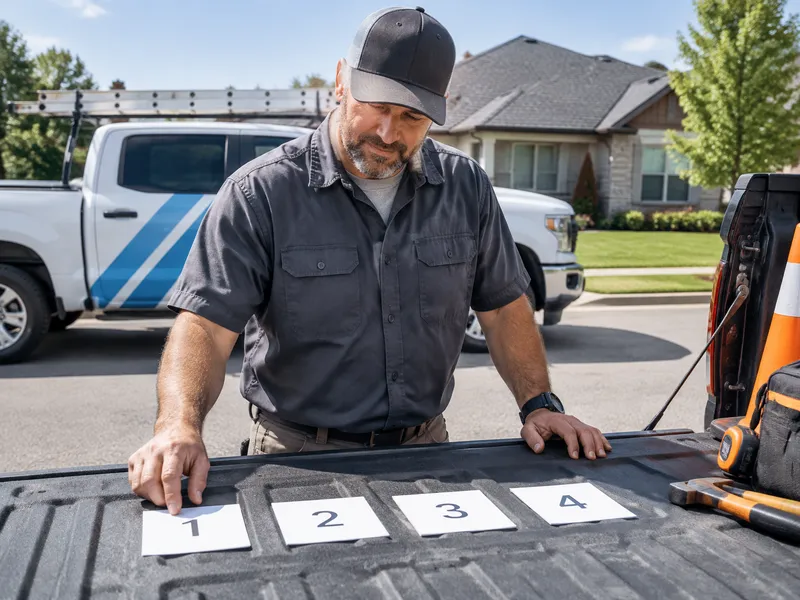
How to market a roofing company comes down to order, not budget.
You are not failing at marketing. You are doing it in the wrong order.
A roof goes on in a sequence. Decking, underlayment, then shingles. Nobody lays shingles first and hopes the deck holds. Marketing works the same way. When the pieces go down in order, each one makes the next one pay. When they go down out of order, you buy the same lost job over and over.
Here is what the wrong order looks like from the driver's seat:
- •You turned on ads and the phone rang twice, both for jobs you could not use.
- •Your Google profile still has the photo from 2019.
- •Your website says "family owned since 1998" and says nothing about her leak.
- •A homeowner called, got voicemail, and called the next roofer.
- •You paid for traffic and have no idea which call became a signed job.
None of those is a budget problem. They are sequencing problems, and they have a fix. It is four steps, and the order matters more than the spend.
How to Market a Roofing Company in Four Steps
Do them in this order, and do not start step 3 until steps 1 and 2 hold up.
- 01.
Fix the storefront.
Your Google Business Profile and your reviews are the first thing a homeowner sees. Put up current photos of real jobs, a correct service area, and a steady flow of new reviews. This is the sign on your building. The Maps Pack is where roofing calls start covers why. - 02.
Give the website one offer.
A homeowner with a leak wants one clear next step, not a page about your history. Pick the offer and make it the first thing she sees. Your roofing website needs an offer, not a price covers how. - 03.
Buy traffic last.
Once the storefront and the offer are working, ads send people somewhere that can win the job. Skip the first two and the ads just find new ways to lose it. The roofing PPC landing page mistake shows what that looks like. - 04.
Answer every call and follow up on every estimate.
The first three steps get the phone to ring. This one turns a ring into a booked estimate. Start it the day your first call comes in. Homeowners do not leave voicemails anymore explains why a missed call is usually a lost one.
Why Ads Come Third, Not First
Advertising for a roofing business is a multiplier. It does not fix what it lands on. It sends more people to whatever is already there.
If your profile is thin and your website has no offer, ads put more homeowners in front of a weak storefront. You pay for each click, and the same job still walks to the next roofer. You did not buy more work. You paid more to lose the same work.
Now flip it. Say the profile is current, the reviews are steady, and the website leads with one clear offer. The same ad spend now sends people to a place that can win the job. Nothing about the ad changed. What it lands on did.
Think of it like a crew truck. Putting more fuel in a truck with a bad tire does not get you to the job site faster. Fix the tire first, then fill the tank.
That is why how to market a roofing company is an order question before it is a budget question. A small spend in the right order beats a big spend in the wrong one.
What a Homeowner Sees When You Skip Step One
Walk it from her side. It is a Tuesday night. A drip has started in the hallway ceiling, and she is on her phone looking for a roofer.
She searches, and your listing comes up. Here is what she checks before she ever dials:
- •The listing. — Is the phone number right? Does the service area include her street? Are the hours real, or is it blank?
- •The reviews. — Is anyone talking about you lately? A roofer whose last review is from a few years back looks like a roofer who has gone quiet.
- •The photos. — Are those real roofs from real jobs, or one dim shot of a truck? She is trying to picture you in her driveway.
- •The website. — She taps through. Does it tell her what to do next, or does it tell her about you?
She is not being picky. She is nervous. A roof is a big decision, and she has nothing else to go on.
Thin listing, stale reviews, a site that is all "about us." She does not give you a chance. She taps the next roofer.
You never see that happen. There is no missed call to look at, no voicemail, no note. The job just never shows up. That is what makes step one easy to skip and expensive to skip.
How to Know the Order Is Working
You do not need four dashboards. You need one number: booked estimates, by source.
A booked estimate is a homeowner with a time on your calendar for you to come look at her roof. Calls do not count. Clicks do not count. Reviews do not count. They are all signs of life, but the estimate on the calendar is what pays the crew.
Keep it simple:
- 01.
Ask every caller how they found you.
Google listing, website, an ad, a neighbor's yard sign, a referral. Write the answer down every time. - 02.
Mark which calls became booked estimates.
A ringing phone and a booked estimate are two different things. The gap between them is where step four lives. - 03.
Tally it by source at the end of each month.
Four columns on one sheet is enough.
Then read it in the same order you built it:
- •Listing source growing. — Step one is working.
- •Website calls turning into booked estimates. — Step two is working.
- •Ad calls turning into booked estimates. — Step three is working. If ad calls are coming in but not booking, go back to steps two and four before you spend another dollar.
- •Booked estimates climbing while call volume stays flat. — Step four is working. You are answering and following up, so more of the same calls are turning into work.
If one source stalls, you know which step to fix. You are not guessing, and you are not paying to find out.
Frequently Asked Questions
►How much should a roofing company spend on marketing?
There is no number that fits every roofer. Anyone who hands you one without knowing your crew size, your service area, and your close rate is guessing. A better question is what each step has to prove before you add the next one. Spend enough to get the storefront and the offer working first. Then let booked estimates by source tell you where the next dollar should go.
►Should I start with Google Ads or my Google Business Profile?
Start with your Google Business Profile. It is the first thing a homeowner checks, and it costs effort rather than ad spend. Ads send people to your storefront. If the profile is thin or the reviews are stale, the ad pays to show her something that loses the job.
►How long does it take for roofing marketing to work?
It depends on the step. Fixing a profile and asking for reviews is work you can finish quickly, but reviews build as jobs close. Ads can put calls on the phone sooner than organic search, but only if the page and the follow-up are ready. Track booked estimates by source each month. You will see which step is moving instead of waiting on a single date.
►Do I need a new website before I run ads?
Not always. You need a website with one clear offer that a homeowner with a leak can act on. If your current site already does that, keep it. If it mostly talks about your history and gives her no next step, fix that first, because ads will send traffic straight to it.
The Search-to-Booked Roofing System™ makes the roofer findable before the homeowner calls. It is built in layers, so the storefront and the follow-up are working before a dollar goes to ads.