
Roofing company owners have been chasing page one for fifteen years.
Some got there. A lot of them are still waiting for the calls that were supposed to follow.
The gap between ranking and ringing is bigger than most people realize. And for local searches, the map pack is where the calls actually come from.
The Misconception That Costs Real Money
When a roofing owner says they want to rank on Google, they usually mean organic results. The blue links. The list that loads when someone types a keyword and hits search.
That framing made sense a decade ago. It does not reflect how homeowners find and call roofers today.
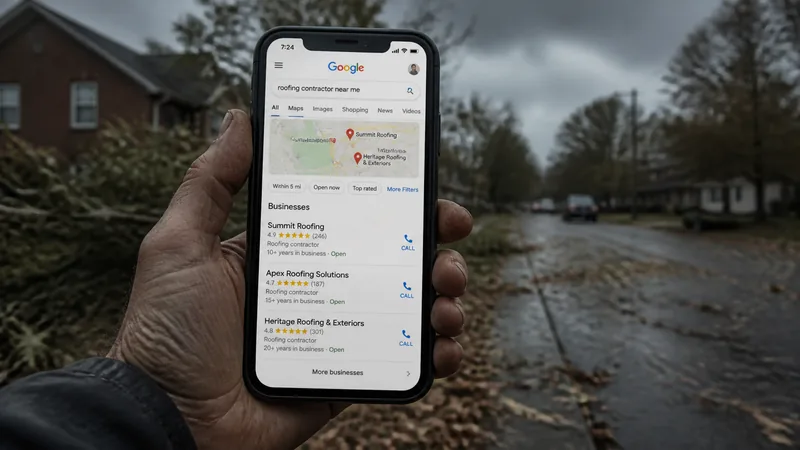
Search "roofing company near me" on your phone right now. The first thing you see is not a list of websites. It is a map, with three businesses, star ratings, distances, and phone numbers. Those three companies are the market for that search.
Organic results sit below the map. On a mobile screen, below the map is further than most homeowners ever scroll.
Increasingly, she does not need to scroll that far. A growing share of searches now end right there in the map card, with no click to any website at all.
What Happens in the First Sixty Seconds
A homeowner comes home and finds shingles in the yard after a windstorm. They are still standing outside, watching the weather clear. They pull out their phone.
They type "roofer near me." The map populates. They look at the top name. They see 187 reviews next to one company and 9 next to another.
That is the decision. It took forty seconds.
They did not compare service pages. They did not read an About Us section. They saw enough to trust one company and not the other, and they called.
BrightLocal's Local Consumer Review Survey shows that the overwhelming majority of consumers use Google to evaluate local businesses, and that review count and recency directly influence who they contact. The map pack is where that evaluation happens. Before a word on any website ever gets read.
Three Spots. That Is the Entire Market.
Google shows three roofing companies in the local pack. Not ten. Three.
In a competitive city, there may be thirty contractors operating. The homeowner sees three of them when they search. The other twenty-seven do not exist for that call.
Moz's Local Search Ranking Factors research identifies three primary drivers of map pack placement: proximity to the searcher, relevance to the search query, and prominence built through reviews, activity, and profile engagement. Companies that have built those signals consistently hold positions that take real time and sustained effort to displace.
For a company sitting at position four or lower, the question is not whether they are losing calls. They are. The question is whether that number would change how they are spending their marketing budget.
Position four does not get a runner-up trophy. It gets nothing. That is exactly why showing up first matters more than showing up eventually in a local market.
The Setup That Costs Roofers Calls
The most common mistake is filling out a Google Business Profile and walking away.
The basics got covered three years ago. A few photos were added. Reviews get a response when someone on the office staff remembers.
That is not a presence. That is a placeholder.
Google reads every signal on that profile. How recently activity was posted. Whether reviews were responded to and how quickly. Whether the service categories match what homeowners in the area are actually searching for.
An inactive profile signals an inactive business. Search Engine Land coverage of GBP ranking behavior makes clear that completeness and engagement are direct factors in how profiles rank in local results. A competitor with a simpler website can outrank a company with a $20,000 site because they stayed active on their profile and collected reviews consistently.
The profile is not an afterthought. It is the storefront. Too many roofers are running theirs like a closed sign in the window. And when the profile does work and the phone rings, what happens next matters just as much. See why homeowners do not leave voicemails anymore.
The Calls That Left No Trace
Here is the part that is difficult to sit with.
Every day, homeowners in your market search for a roofer. Some are ready to book today. Some have had damage sitting for weeks and finally decided to call. Some are property managers responsible for a portfolio of buildings and three roofs that need attention before fall.
If your company is not in the top three when they search, they do not know you exist. There is no notification. No missed-call report for leads that never reached you. The job went somewhere else and the conversation is already over.
Think With Google research shows that local searches convert to calls at high rates on mobile, with behavior concentrated in the top results before the user considers scrolling. The calls are happening right now in your market. The question is which three companies are getting them.
The revenue a roofing company cannot see is the most dangerous kind.
Most owners only measure what came in. Almost nobody measures what passed them by.
What It Looks Like When It Is Working
The roofing companies holding top map pack positions in competitive markets are doing something straightforward at a level that almost nobody in the industry sustains.
Reviews collected after every completed job. Not occasionally. Every job, every time. A consistent stream of recent reviews signals an active, trusted business to both Google and the homeowner reading the profile. Stale reviews signal a company that used to be busy.
Photos updated regularly with real work from the local area. Not stock images of generic rooftops. Actual roofs, actual crews, actual neighborhoods the homeowner can recognize from their own street.
Every review responded to. Including the critical ones. Especially the critical ones. The way a company handles a bad review is one of the clearest signals a skeptical homeowner can read before they call. It shows how the company handles problems on the job.
None of this is difficult. It is just consistent. And in roofing, consistency at this level is rare enough to be a genuine competitive advantage over everyone in the market who started and stopped.
The homeowner is not comparing websites. They are comparing three tiles on a map in the time it takes to decide whether to tap or keep scrolling.
The calls go to whoever earned that spot before the homeowner ever started searching.
The Search-to-Booked Roofing System™ Scorecard shows exactly where your local presence is working and where it is costing you calls. Takes five minutes.