
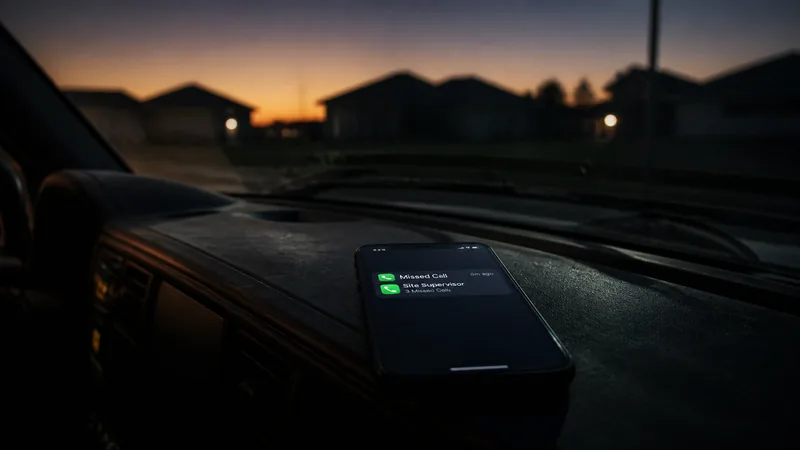
The phone rings. Nobody answers. The homeowner hangs up.
That is the entire story. That is the job you just lost.
Not to a better roofer. Not to a lower price. To a company that picked up.
The Voicemail Is Already Dead
Homeowners do not leave voicemails. This is not an exaggeration. It is what is actually happening in your market right now.
A decade of texting rewired how people handle uncertainty. If they call and nobody answers, the transaction ends. There is no second thought about leaving a message. No patience for a callback that comes two hours later.
They move to the next result on their phone.
Invoca, one of the largest call-tracking platforms in the home services industry, analyzed tens of millions of inbound calls and found that less than 3% of callers pushed to voicemail actually leave a message. The other 97% hang up and call someone else.
That number should stop you cold.
What makes this especially costly for roofing companies is the moment when most of these calls happen. A hail event moves through a neighborhood. An adjuster completes a walk. A homeowner notices a stain on the ceiling on a Tuesday morning.
These are not planned purchasing decisions. They are urgent moments. The window is short. The tolerance for friction is zero.
A roofing company that does not answer that call does not get another chance at it.
The Part Nobody Talks About
The missed call problem is real. But it is only half the issue.
The other half is what happened before the call.
The homeowner did not stumble onto your number randomly. They searched, read enough to feel something, and decided to call you specifically. That sequence took effort. It represented real intent.
When the phone rings out, all of that effort they spent choosing you gets handed to your competitor.
That is the actual cost. Not just a missed call. A qualified homeowner who already decided you were worth calling, redirected because nobody answered. If you want to see where those calls are coming from in the first place, read why the maps pack is where the calls come from.
If you understood how many searches end in a call to your company every week, and then understood what percentage of those calls you are actually capturing, the math would be uncomfortable.
Most roofing owners have never looked at it that way. The missed calls are invisible. The jobs that never made it to an estimate never show up in revenue figures.
Invisible losses are the most dangerous kind.
Why Hiring a Receptionist Does Not Fix It
The obvious answer is to hire someone to answer the phone. A lot of roofing companies have tried this. Most have not solved the problem, and the reasons are structural.
A receptionist works business hours. Homeowners search in the evening. After they put the kids to bed. After the adjuster visit wrapped up at 6:30. After they finally had a moment to deal with the thing they have been putting off.
The calls that come in between 6pm and 9pm on a weeknight are not low-quality leads. They are often the most motivated homeowners in your pipeline.
ServiceTitan, whose platform runs inside thousands of roofing and home services companies, published data showing that 18% of home services calls go unanswered on weekdays. On weekends, that number jumps to 41%.
A receptionist who clocks out at 5 does not capture any of it. And during the hours she is working, the phone still rings when she is already on another line.
There is also the consistency problem. A good receptionist converts well. A distracted one does not. A new one does not. The variance is high, and a homeowner who was already uncertain only needs one flat interaction to move on.
The phone is not a staffing problem. It is an infrastructure problem.
What Smart Operators Are Doing
The roofing companies solving this are not hiring more people. They are installing systems that operate when people cannot.
AI-powered response systems that answer calls around the clock, handle the intake conversation naturally, book an estimate on the calendar without a human in the loop, and follow up on missed calls within minutes.
The homeowner calls at 8pm on a Thursday. Has a real conversation. Wakes up Friday morning with an estimate already on the schedule.
Nobody on the roofing side did anything. The system handled it.
The follow-up piece matters just as much. A homeowner who calls and does not reach anyone sometimes does come back, if they hear from the company fast enough. The window on that recovery is narrow.
Harvard Business Review's foundational research on lead response found that firms contacting leads within an hour were seven times more likely to qualify the lead than those who waited. The data on follow-up speed is even more direct: respond within five minutes and the conversation is still alive. Wait thirty minutes and the homeowner has already scheduled with someone else.
Speed is trust. Slow follow-up is a trust signal in the wrong direction. Answering the call is the first test. What you say in the next fifteen seconds is the second, and it's just as easy to lose. See why answering fast still is not enough to win the job. Losing the job after a good estimate usually starts the same way, with a follow-up that came too late.
When a homeowner decides to call you, they have already done the hard work of choosing you. The only thing left is for you to be there.
The phone is not where you win the job. It is where you keep it.
The Search-to-Booked Roofing System™ Scorecard walks through the same signals Google, AI, and homeowners use to decide who to trust. Ten minutes. Free. Built for roofers.