
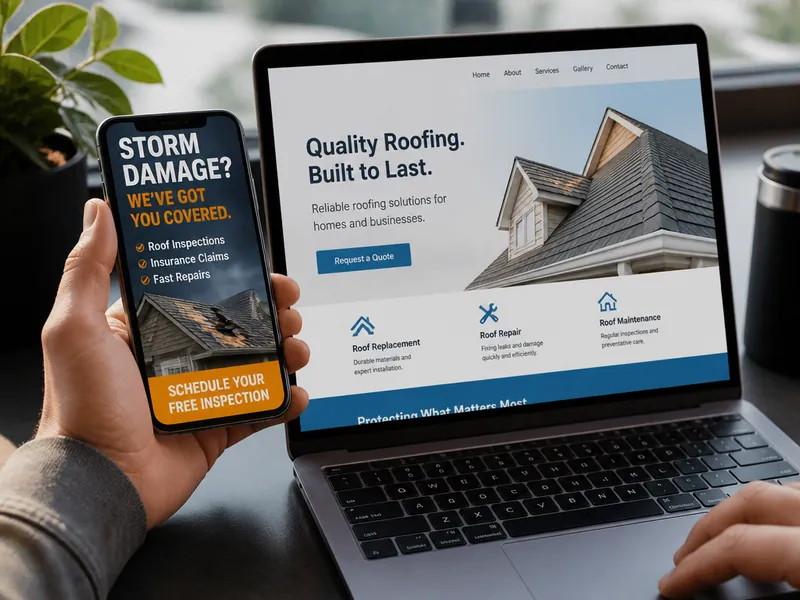
Your PPC ad made a promise. The homeowner needed storm damage help right now. They clicked because that promise mattered.
Then they landed on your homepage. A hero photo. A phone number.
A list of every service you offer. Nothing about the storm. Nothing about the promise that got the click.
That gap is not a technical problem. That is a trust problem. And it is bleeding your ad budget dry, one click at a time.
- •You checked your Google Ads cost per click today and winced.
- •A homeowner clicked your storm damage ad and left in four seconds.
- •Your ad spend went up this month, but booked inspections did not.
- •Every click, storm damage or not, lands on the same generic homepage.
- •You could not tell me if last week's ad spend booked a single job.
Why Your Competitor's Ad Gets the Call and Yours Gets the Bounce
Somewhere in your market, another roofer is running the same kind of ad. Same keyword. Same storm. Different result.
His ad says "storm damage repair." A homeowner clicks. The page they land on says "storm damage repair" back to them: in the headline, in the first line, in the button.
That is called message match. It is not a marketing term you need to memorize. It is just this: the page has to keep the promise the ad made.
Google has a name for this too. It calls it Landing Page Experience, one of three things it checks before deciding what you pay per click.
This holds whether the click came from Google Ads or from ChatGPT Ads. The platform changes. The page still has to keep the promise.
Your page does not keep that promise. It introduces your company instead of speaking to the homeowner who just clicked. By the time they find something that matches what they came for, they have already left.
Not because your work is worse. Because the page made them work for it.
What They're Doing Differently on the Page After the Click
His landing page is not fancy. It just matches.
The headline repeats the ad, not the company name, not a tagline. The exact promise: storm damage repair, today.
Everything else on the page earns its place or gets cut:
- •One headline — Repeats the ad's promise, not a company slogan.
- •One photo — Shows storm damage, not a stock roof.
- •One phone number and one button — No menu. No distractions.
- •No service list — Just the one problem the ad promised to solve.
- •One line of proof — A review, a response time, a guarantee. One is enough.
That page has one job. Get the phone to ring for this homeowner, about this problem, right now.
How to Build a Landing Page That Matches the Ad
This is not a rebuild. You do not need a new website. You need one page for every ad that is worth the click.
Start with the ad. Whatever it promises, storm damage repair, free inspection, insurance claim help, that promise becomes the headline on the page. Word for word if you can manage it.
Cut the site navigation. A homeowner arriving from an ad should not have five ways to leave before they call.
One page. One promise. One button.
If you run three ad angles: storm damage, roof replacement, insurance claims, build three pages. Not because it is more work for the sake of it. Because each homeowner clicked for a different reason, and each page should meet them there.
Why This Matters Most Right Before Storm Season
Storm season is not slow days spent hoping the phone rings. It is homeowners searching in a hurry, comparing three roofers in the same ten minutes.
That is when a mismatched landing page costs you the most. Not in a slow month, when a homeowner has time to dig through your site anyway.
In the week after a hailstorm, three other roofers are running the same ad you are. The first page that matches the promise wins the call.
Being found matters. So does what happens after the click. A homeowner who found you through the Maps Pack already trusts you enough to forgive a generic page.
A homeowner who found you through a paid ad has made no such commitment yet. The page still has to earn it. Every time.
►What is message match in a roofing PPC ad?
Message match means the page a homeowner lands on repeats the exact promise made in the ad. If the ad says "storm damage repair," the headline on the landing page says the same thing. When the words match, the homeowner trusts they are in the right place. When they do not, most leave in seconds.
►Do I need a separate landing page for every ad campaign?
Not every ad, but every distinct promise. A campaign for storm damage repair and a campaign for full roof replacement are different promises to different homeowners. Each one needs its own page. Grouping them under one generic page is what breaks message match in the first place.
►How much does sending PPC clicks to a homepage actually cost?
It shows up as a high cost per booked inspection, even when the cost per click looks fine. You are paying full price for the click and then losing most of its value on a page that does not close the loop. The ad spend did its job. The page did not.
►Can one landing page work for both storm damage and roof replacement ads?
Only if the language is broad enough to cover both, and broad language is exactly what breaks message match. A homeowner clicking a storm damage ad wants storm damage language, not a page trying to speak to two problems at once.
A landing page is one fix. It is not the whole system. Search-to-Booked builds the entire path: the ad, the page that matches it, and the follow-up after. So the homeowner you already paid to find still turns into a booked inspection.