
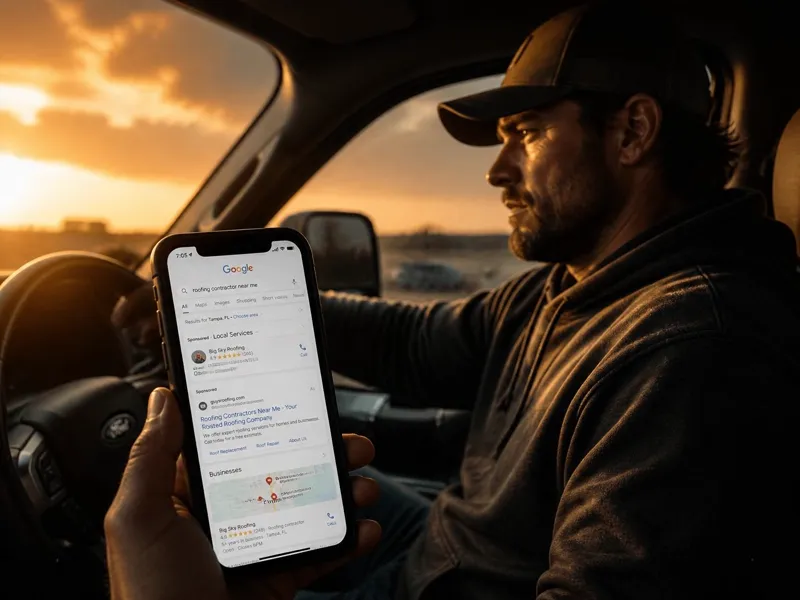
A homeowner searched for a roofer in your market this morning. She saw two names above every Google Ad on the page. Above the Maps Pack. Above everything you have built online.
Neither one was yours.
That row belongs to Google Local Services Ads. Two or three verified roofers with their rating, their phone number, and a blue Google checkmark. She tapped the first name. She is already on the phone. She never scrolled to where you are.
Here is what that costs you every day you are not in that row:
- •Your Google Ads are running below LSA listings — you are paying per click for a position that is already one step behind
- •Your Maps Pack ranking took months to earn and it still sits below verified LSA roofers on every search
- •You checked your market recently and the roofer with the checkmark is getting calls you never even knew you were losing
- •You assumed Google Local Services Ads were too complicated, too expensive, or not available in your area — and moved on
- •A homeowner needed a new roof last week. She called the first name she saw. It was not yours.
Google Local Services Ads are not a replacement for the Maps Pack or your organic presence. They sit above both. And they charge you only when a homeowner actually contacts you — not when she clicks, not when she bounces, not when she calls someone else.
This post covers what LSAs are, what they cost, what Google requires to get verified, and how to get into that top row.
What Google Local Services Ads Actually Are
Google Local Services Ads are a pay-per-lead advertising product built specifically for local service businesses.
Roofers are an eligible category.
When a homeowner searches "roof repair near me" or "roofing contractor in Dallas," a row of LSA listings appears at the very top of the page. Above paid Google Ads. Above the Maps Pack. Above every organic result you have ever ranked for.
Each listing shows your business name, your star rating, your city, and a blue checkmark.
That checkmark is the Google Verified badge. It tells the homeowner that Google has confirmed your license, your insurance, and your background before she ever picks up the phone.
Here is what matters most about how LSAs charge you.
You pay only when a homeowner contacts you through the ad. A phone call. A message. A booking request. Not a click. Not someone who saw your listing and kept scrolling. An actual homeowner who reached out.
Traditional Google Ads charge you per click regardless of what happens after. LSAs charge you per lead. That is the whole difference.
Two to three LSA listings typically appear above the fold on a local home services search. The homeowner can expand the list to see more. But the roofers in those first two or three spots are the ones getting called before anyone else on the page gets seen.
One important update if you have not heard: Google retired the Google Guaranteed badge in October 2025. Google Screened and License Verified went with it. All three were replaced by a single Google Verified badge — the blue checkmark.
The verification process did not change. The name did.
That was not the last change coming to this program. Google is folding Local Services Ads into Google Ads as a Performance Max campaign type, with roofing named in the first wave. Here is what changes and when.
If you have a yard sign, a truck wrap, or a website that still says "Google Guaranteed," that language is outdated. Update it.
And the money-back guarantee that used to come with the Google Guaranteed program was discontinued on November 7, 2025. The badge now signals that Google has vetted your business. Not that Google is standing behind your work financially.
That distinction matters if you have been marketing the guarantee to homeowners.
What You Pay — and What You Don't
The pay-per-lead model is what separates LSAs from everything else Google sells.
With traditional Google Ads, the meter runs on clicks.
A homeowner sees your ad. She clicks it. She lands on your website. You pay — whether she calls you, books an estimate, or closes the tab two seconds later.
Roofing is one of the most expensive categories on the platform. LocaliQ's 2025 Home Services benchmark tracked 3,211 US campaigns. Roofing and gutters came in with the highest average cost per lead of any home services subcategory. $228.15 per lead.
LSAs work the other way.
You pay when a homeowner contacts you through the ad. A call where you speak with her. A voicemail she leaves. A message she sends. If she sees your listing and keeps scrolling, you pay nothing.
Here is how the two compare:
| Google Local Services Ads | Traditional Google Ads | |
|---|---|---|
| What triggers a charge | Homeowner calls or messages you | Homeowner clicks your ad |
| Roofing cost per lead | $55-$95 non-storm / $150+ storm season | $228.15 average (LocaliQ, 2025) |
| Payment model | Pay per lead | Pay per click |
| Source | SearchLight Digital, Feb 2026 | LocaliQ, 2025 |
: What triggers a charge
- Google Local Services Ads
- Traditional Google Ads
: Roofing cost per lead
- Google Local Services Ads
- Traditional Google Ads
: Payment model
- Google Local Services Ads
- Traditional Google Ads
: Source
- Google Local Services Ads
- Traditional Google Ads
At a $75 average LSA lead cost and a 35 percent close rate, you are spending roughly $215 in ad costs for every job you book.
On a $10,000 roof, that math holds up.
And a homeowner who calls through an LSA is already looking at your rating and your verified badge before she dials. She is further along than someone who clicked a Google Ad and landed cold on your website.
One more thing the model gets right.
If a lead comes through that is clearly invalid — wrong number, spam call, someone asking about a service you do not offer — Google's automated credit system reviews it. Credits are issued for leads that do not meet the threshold for a valid lead.
You can also flag questionable leads through the Lead Feedback Survey in your LSA dashboard. That trains the algorithm over time to send fewer mismatched calls your way.
You are not locked into paying for junk. But the system works best when you answer fast and rate your leads consistently.
What Google Requires to Run Them
I spent five years on roofing crews before I spent thirty years in technology. I have seen both sides of the verification question — what Google actually needs from a contractor and what makes the process stall.
It is not complicated. But it has to be done right the first time.
For roofing contractors, Google requires three things. Get these ready before you start the application and you will move through faster than most.
- •General liability insurance. — Submit a current Certificate of Insurance showing active GL coverage. This is non-negotiable. No COI, no badge. A lapsed certificate is the most common reason applications stall.
- •Your business license. — Google verifies your state or local roofing contractor license where one is required in your area. The name on your license needs to match the name on your business registration exactly. A mismatch is the second most common reason applications stall.
- •A background check on the business owner. — Roofing contractors are not required to submit field worker background checks. That requirement applies to trades like HVAC, plumbing, electrical, and locksmiths — not roofing. The process is simpler for roofers than most guides written for general contractors will tell you.
Google's stated average for completing screening and verification is three to four weeks from the time you submit your documents. Background checks typically clear in the first week. If your paperwork is clean and your names match, you are often live faster than that.
There is also a pre-badge option. Google allows eligible roofers to begin receiving leads before full verification is complete. Your listing goes live at a lower ranking position while the remaining checks finish. You are not sitting idle for a month waiting — you are in the game at a lower position while the clock runs on verification.
One important caveat: LSAs are not available in every market. Availability depends on your service area, local competition density, and licensing requirements. Do not assume you are eligible based on a neighboring city. Check your specific ZIP code at ads.google.com/local-services-ads before you spend any time on paperwork.
How Google Decides Which Verified Roofer Gets the Call
Getting verified puts you in the game. It does not put you at the top.
Google runs an auction for LSA placement. Two inputs determine where you rank: your bid and how likely Google thinks your ad is to result in a lead.
That second factor is where most roofers either earn the top spot or quietly lose it.
Google's own documentation confirms the signals that feed that score. Every one of them is within your control:
- •Your reviews and rating. — A roofer with 80 reviews and a 4.7 rating ranks above a roofer with 12 reviews and a 4.2 rating, all else being equal. Industry agencies commonly recommend 4.5 stars or higher and 50 or more reviews before launching. Those are agency benchmarks, not published Google thresholds. But the direction is right — more reviews, higher rating, stronger placement.
- •Your response time. — This one has teeth. Google tracks how quickly you respond to LSA leads. A call that rings through and goes to voicemail during business hours is a signal to Google that you are not reliable. Your ranking drops. The next roofer in the queue gets that homeowner's call. Google does not publish a specific response-time number. What is confirmed is that slow or missed responses move you down the list.
- •Your profile completeness. — Fill out every field. Add photos of finished jobs. Keep your service area accurate. Select only the job types you actually want leads for. A sparse profile ranks below a complete one. This is the easiest win on the list and the one most roofers skip.
- •Your budget. — Set it too low and Google stops showing your ad before the week is out. Ranking momentum takes time to rebuild after a pause. Stay consistent — especially during storm season when lead volume spikes and competition for placement gets tighter.
The roofer at the top of the LSA row answers fast, has strong reviews, keeps his profile current, and does not let his budget run dry mid-week.
The roofer who set it up six months ago and has not touched it since is paying for a position he stopped holding.
Where LSAs Fit in the Bigger Picture
LSAs are not a replacement for your Maps Pack ranking or your organic search presence. They are the top layer of a three-layer visibility stack.
Here is how the page breaks down when all three are working:
At the top sits your LSA listing. Two to three verified roofers, ratings visible, one tap to call. The homeowner who clicks the first thing she sees calls from here.
Below that is the Maps Pack. Three local businesses with reviews, photos, and directions. A roofer with a strong Google Business Profile and consistent reviews earns his place here. Homeowners who scroll past the LSAs often stop at the Maps Pack before they ever reach organic results.
Below that is organic. Your website, your Field Notes content, your topical authority built over months. It matters. But it is the third thing a homeowner sees, not the first.
A roofer with only SEO is starting every search two paid placements behind a competitor who has LSAs. A roofer with LSAs and the Maps Pack is visible at the top two sections of the page before a single organic result appears.
Your competitor with the blue checkmark is not better at roofing than you. He just shows up first. And the homeowner who calls the first name she sees never gets to the second one.
The LSA slot is sitting empty in most roofing markets. The roofer who claims it first owns the top of that page. The one who waits hands it to whoever moves faster.
►Is my roofing business eligible for Google Local Services Ads?
Roofing is an eligible category under Google's Home Services program in most US markets. Eligibility depends on your specific service area, local licensing requirements, and competition density in your ZIP code. Not every market is covered. The fastest way to find out is to use Google's eligibility checker at ads.google.com/local-services-ads. Enter your ZIP, your state, and your job category and Google will tell you whether LSAs are available where you operate.
►What happened to the Google Guaranteed badge?
Google retired the Google Guaranteed, Google Screened, and License Verified badges in October 2025 and replaced them with a single Google Verified badge — a blue checkmark that appears on every verified LSA listing. The verification process itself did not change. What changed is the name and the consumer-facing guarantee. The money-back program that used to come with the Google Guaranteed badge was discontinued on November 7, 2025. The badge now signals that Google has verified your license, insurance, and background. If your marketing materials still say Google Guaranteed, update them.
►Can I run LSAs and Google Ads at the same time?
Yes. They are separate products that serve different moments in the search. LSAs appear above Google Ads and charge per lead. Google Ads appear below LSAs and charge per click. Many roofing contractors run both. LSAs capture homeowners at the top of the page who are ready to call. Google Ads reach homeowners earlier in the decision process who are still researching. Running both gives you coverage at multiple points on the page rather than depending on one placement alone.
►What happens if I get a bad lead — am I stuck paying for it?
No. Google's automated credit system reviews leads and does not charge for ones that clearly do not qualify — wrong numbers, spam calls, and similar. For leads that come through but are not a fit for your business, you can flag them using the Lead Feedback Survey in your LSA dashboard. Rating your leads consistently helps train the algorithm to send fewer mismatched ones over time. The old manual dispute tool has been replaced by this automated system, but the ability to flag bad leads and recover credits remains in place.
LSAs are one layer of the visibility stack. Getting verified and showing up in that top row is the first step. What happens after the homeowner calls — whether she books an estimate, whether that estimate closes, whether your phone is even getting answered — is the rest of the system. If you want to see where your roofing company stands across the full stack, the Scorecard will show you exactly where the gaps are.