
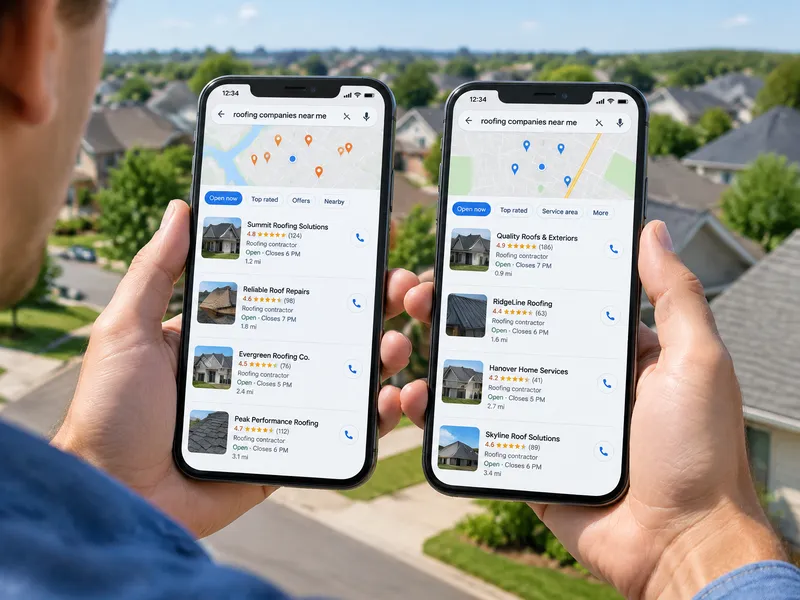
Open your phone and type "roofer near me." Write down who shows up. Now type your city and "roofing." Different list, right?
Same company, two searches, two different results. That gap tells you something, and you can read it in about ten minutes.
A homeowner types one or the other. Which list you are on matters. Here is what that looks like from the owner's chair.
- •You are in the pack from the shop, then gone from the other side of town.
- •You rank in the city next door but not in your own.
- •A competitor with fewer reviews outranks you in your own city.
- •The phone rings, and you cannot tell which search brought the call.
This is a diagnostic, not a ranking play. The test below will not promise you a spot. It will show you where you stand on each search, so you know what to check first.
Two Searches, Two Questions Google Is Answering
Start with what Google says about itself. In its own help pages, Google says local results are based mainly on relevance, distance, and prominence.
Relevance is how well your profile matches what someone is searching for. Distance is how far your business is from the customer who is searching. Prominence is how well known you are, and Google ties it to how many websites link to you and how many reviews you have.
Here is my reading of your two searches. When a homeowner types a city name, the homeowner has told Google a place. When a homeowner types "near me," no place is named.
Google says that if a customer does not share where they are, it uses what it knows about their location. My reading: one search starts from a place the homeowner typed, and the other leans on where Google thinks the homeowner is.
Google also says there is no way to request or pay for a better local ranking. There is no button to press. There is a profile that fits the search, sits close enough, and is well known.
Same profile, possibly two different starting points. That is not a ranking mystery. That is a position you can check.
The Two-Search Test
You do not need a tool for this. You need a phone, a notepad, and about ten minutes.
- 01.
Run both searches at the shop.
Type "roofer near me" and write down what you see. Then type your city and "roofing" and write that down. Note whether your company is in the map pack, further down, or missing. - 02.
Move across town and run them again.
Drive ten or fifteen miles to the far side of your market, or ask a friend there to run both searches and send screenshots. Distance is one of the three things Google weighs, so expect the lists to shift. - 03.
Run both searches from the city next door.
If you take calls there, this is where you want to see your company. Write down what you find, even when the answer is nothing. - 04.
Study who beats you.
At each spot where you drop off, open the profiles that rank above you. Compare review count, rating, and photos. Google ties prominence to reviews, so this shows you the gap. - 05.
Build a simple grid.
Put the two searches across the top and each spot down the side. Mark every box as in the pack, below it, or not there. That grid is your diagnosis.
Do not trust one search from one spot. A single result tells you about that moment. The grid tells you about your market.
Now read the grid. Two patterns are worth reading first, and each one points somewhere different.
If You Win "Roofer Near Me" and Lose the City Name
Here is what the grid says. You show up when the search starts from the homeowner's own spot. You drop out when the homeowner names the city.
I cannot tell you why any single ranking landed where it did. Google does tell us what it weighs. So check those things, in this order.
- •Does your profile say the city? — Look at your service area, your business description, and your website. Google defines relevance as how well a profile matches what someone is searching for. My reading: if the city is nowhere in plain words, you gave it little to match.
- •Who beats you on the city name? — Open their profiles and compare review count and rating. Google ties prominence to how many reviews a business has and how many websites link to it.
- •Is your address and service area accurate? — Google asks for accurate and precise information. It also says a service area generally should not stretch past about two hours of driving from where you are based.
- •Does the homeowner see a reason to pick you? — Once your profile appears, the homeowner has to pick between you and the rest. Not a logo and a phone number. Photos, reviews, and a plain line that says you work in that city.
Do not fix this with a fake address or a list of cities you do not serve. Google's guidelines for representing your business ask for an accurate and precise address and service area. A fake one is a risk you do not need.
If You Win the City Name and Lose "Roofer Near Me"
This is the reverse. You hold up when the homeowner names the city. You fade when Google has to work out where the homeowner is.
Distance is the first thing to look at. Google says distance is how far a business is from the customer who is searching. My reading: if a competitor sits closer to that homeowner, that can help it show.
You cannot move your shop for a search, and you should not pretend to. Leave the pin and the address honest.
- •Find where it breaks. — Look at your grid. Mark the spots where you drop off on the near me search. Those are the places someone else may be closer or better known.
- •Fill in every part of the profile that is true. — Google says complete, detailed business information helps it match your profile to searches. Services, hours, photos, and a clear description all count.
- •Keep reviews coming from real jobs. — Google says more reviews and positive ratings can help your local ranking. Homeowners read them too, so a recent, specific review does two jobs.
- •Pick your ground. — You do not have to win every neighborhood. Choose the ones where your best jobs are and start there.
A homeowner who types the city name is naming a place. A homeowner who types near me is asking who is close. Your position is the story a homeowner reads, search by search.
What to Change First
Start with what costs nothing and can hurt you if it is wrong. Fix accuracy before you chase anything else.
- 01.
Make the address and service area honest.
Your profile should match where you really work. Start with why your service area is smaller than you think to see where your real market sits. - 02.
Say the city in plain words.
Put it in your profile description and on your website, the way a homeowner would say it. If your name is shared with other local roofers, read roofing company names Google can tell apart. - 03.
Build reviews from real jobs.
Google ties prominence to reviews, and homeowners read them before they call. Ask every happy customer, and ask while the job is fresh. - 04.
Run the grid again.
Same two searches, same spots. Do it after you change something, so you can see which change moved the result.
Notice what is not on the list: nothing here promises a ranking. Google says no one can pay for one, and no single search can speak for your whole market.
The reason to care is simple. The map pack is where the calls come from, and your grid shows you which searches put you there.
►Why do I rank for roofer near me but not by city?
Google says it weighs relevance, distance, and prominence, and that it uses what it knows about a searcher's location when none is shared. My reading is that a near me search leans on where Google thinks the homeowner is, while a city search names a place. Run the two-search test from several spots to see where you drop off.
►Does where I search from change the roofing results?
It can. Google lists distance as one of three things it weighs, measured from the customer who is searching. Run your searches from more than one spot, or ask someone across town to run them, before you judge your rankings.
►How do I rank in Google Maps for my city?
Nobody can promise a rank, and Google says there is no way to pay for a better local ranking. What you can control is an accurate, complete profile, the city stated in plain words, and a steady flow of real reviews. Then check your grid again.
►Should I list multiple cities on my profile?
Only the areas you really serve. Google's guidelines ask for an accurate and precise address or service area. They also say a service area generally should not stretch past about two hours of driving. Listing cities you do not serve is a risk you do not need.
The Search-to-Booked Roofing System™ is built around the Map Pack, which starts at Foundation. If your grid shows gaps, that is where we begin.