
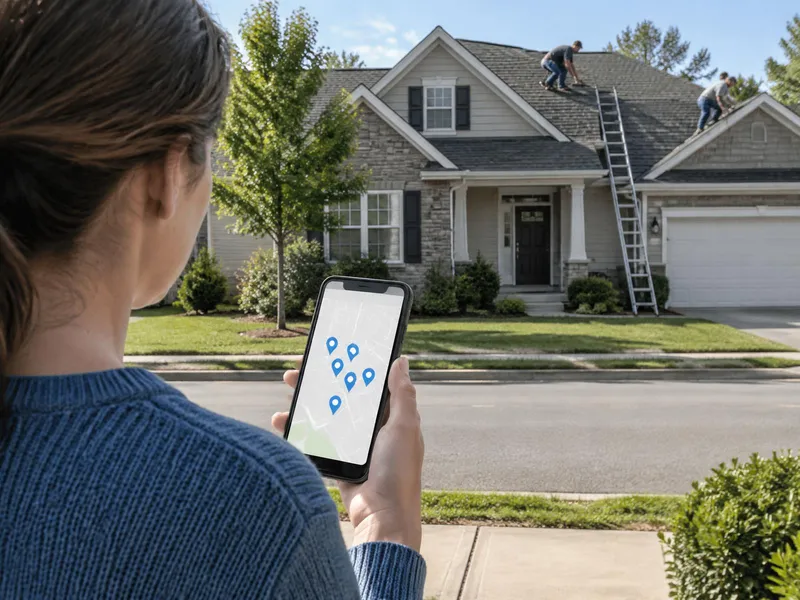
Roofing company names get reused far more often than owners expect. Quality Roofing. ABC Roofing. All American Roofing. Pick any of them and there is probably one in your county, one in the next county over, and one that opened last year.
That is fine on a truck door. It gets harder when a homeowner types the name into Google and Google has to decide which one she meant.
Five Roofers, One Name: What Google and the Homeowner Have to Sort Out
Google does not read your truck. It matches a search to profiles, websites, reviews, and mentions, then decides which business each one belongs to.
Your address, phone number, website, category, and reviews are the clues it uses. A distinctive name gives those clues something to hold onto. A shared name leaves them doing all of the work.
I want to be straight about one thing. I have found nothing from Google saying a common name lowers your rank, and I am not going to tell you it does. What I can tell you is what the confusion looks like, because you can see it in your own results.
It shows up in three places:
- •On the map. Two listings with near-identical names sit a few miles apart, and a homeowner taps the wrong one.
- •In reviews. Praise meant for you lands on another company's profile, or their complaint lands on yours.
- •On the phone. A homeowner calls the wrong Quality Roofing, and that roofer may book the job.
None of that needs a ranking penalty to cost you money. It only needs two businesses that look the same for the length of one search.
What Branded Search Looks Like When Your Name Is Not Distinctive
Branded search is when a homeowner types your company name straight into Google. It is one of the most valuable searches you get, because she already has a reason to call you. A neighbor mentioned you. She saw your truck on the next street. Your yard sign was in front of a house down the road.
All she remembers is the name. The search is the last step before the phone.
With a distinctive name, that search returns you. With a shared one, she can land on any of these:
- •Another company's profile in the map results
- •A directory page listing three businesses with the same name
- •Someone else's website sitting above yours
- •A review count that belongs to the other roofer
She does not know there is a second company. She sees a listing, a rating, and a number, and she calls it.
You will not see this from your own desk. Your searches are shaped by where you are and what you have searched before, and you will always find yourself. The only way to see what she sees is to search the way she does, which is exactly what the test in the next section walks through.
The Name Test: Five Searches Before You Print Another Truck Wrap
Run these on your phone, the way a homeowner would. Use a private browser window so your own history does not flatter you. Your location will still shape the results, and that is the point, since it is close to what a homeowner in your town sees.
Keep a notepad open. You are counting how many times someone other than you shows up.
- 01.
Search your exact name with your city.
Type it the way a neighbor would. Look at the map results first, then the first page. Is the first business you see actually you? - 02.
Search the name alone, with no city.
Now look for other companies with the same or nearly the same name, anywhere in the region. Note how far away the nearest one is. - 03.
Open Google Maps and search the name.
Zoom out to roughly an hour's drive in every direction. Count the profiles with your name or a close variation. A homeowner will see the same pins. - 04.
Search your name followed by the word reviews.
Read whose reviews appear and whose star rating sits at the top. If another company's rating is the first thing a homeowner sees, you have found the leak. - 05.
Check the registries.
Search your state's business entity records and the federal trademark database for your name. This is not legal advice. It simply shows who else has already claimed the name or something close to it.
Reading your results: if a homeowner could land on someone else at any step, you do not have a distinctive name yet. If you land on yourself every time and nobody close to you shares the name, you are in good shape. If the answer lands somewhere in between, the rest of this post covers what to do about it.
If you are still choosing a roofing company name, run the same five searches on every candidate before you register anything. It takes an afternoon. Changing a name after the trucks are wrapped takes a lot longer.
What a Distinctive Roofing Name Looks Like
A name is easy to confuse when it is built from the same few parts everyone else uses. A trust word like Quality, Premier, or Elite. A patriotic word. A roofing word. Stack two or three of those together and you have a name that someone in your region probably already owns.
Names that are easy to tell apart tend to share a few traits.
- •One word nobody else uses. A founder's uncommon surname, a made-up word, or a local reference with some history behind it. Run it through the test from the last section before you fall in love with it.
- •Easy to spell after hearing it once. A neighbor says your name over a fence. The homeowner has to type it from memory. If she has to guess the spelling, she may land on someone else.
- •Different from the names around you, not just from the names in your head. Check the roofers within an hour's drive, because those are the ones sharing your results.
A common surname is a mixed bag. It is personal and it builds trust, but it is also easy to duplicate.
Notice what is not on the list: the word roofing. Your profile category is where you tell Google you are a roofer. The name's job is to tell people which roofer.
One caution if you are tempted to add a city or a service to the name for search. Google's profile rules say the name should match your real-world name. I cover what that means in the next section.
Already on the Door: What You Can and Cannot Change
If the name is already on the trucks, the invoices, and the license, you have more options than a full rebrand. You also have one move that looks like a shortcut and is not.
The shortcut that backfires: adding your city, a service, or a distinguishing word to your Google Business Profile name when it is not on your signs. Google's guidelines say the name should reflect your real-world name, as used on your storefront, website, and stationery. Extra words can lead to suspension. That is a big price for a small edit.
A modifier that is real: if you want a distinguishing word in the name, it has to exist everywhere first. On the trucks, the website, the paperwork, and registered as a trade name where your state requires it. Once it is real, the profile can match. Ask your state or an accountant how trade names work where you operate. I am not a lawyer, and this varies by state.
What helps without touching the name:
- •Use your full name the same way everywhere, starting with your website header and footer.
- •Put your website address and phone number on every truck and yard sign, so a homeowner who remembers the name still has a route to the right business.
- •Fill out your profile completely, so it gives Google more to match against than a name alone.
The consistency side of that is covered in The Silent Reason Google Stops Trusting Your Roofing Company.
If you do change the name: Google can ask you to re-verify a profile when business details were recently updated, and a name change may trigger that. Line up your proof first. Signage, paperwork, and a website that already shows the new name. I would also change the name field on its own, not in the same week as an address or phone change. That is my practice, not a Google rule.
When a Rebrand Is Worth the Cost
A rebrand is not a search tactic. It is a business decision, and it costs trucks, signs, paperwork, and every listing that carries your old name. Make it on what the test showed, not on a hunch.
Lean toward a rebrand when:
- •Homeowners could land on someone else in more than one of the five searches
- •The other company with your name is established, with its own reviews and its own pull on the map
- •A trademark or registry search turned up a conflict, which is a question for a lawyer before anything else
- •You plan to grow into new towns, where a name that is already crowded will be harder to keep distinct
Lean toward keeping the name when:
- •You land on yourself in every search
- •The nearest namesake is far enough away that your customers never meet it
- •Your name carries real weight with the homeowners and referrals you already have
If you land in between, keep the name and do the work from the last section. Match it everywhere, put your website and phone on every truck, and complete the profile.
If you do rebrand, update every listing and keep the information identical across them. Until they all match, you are back in the consistency problem. Google may ask you to verify again, and do not promise yourself a date for when everything settles.
The name matters most where the calls come from. That is the Maps Pack, where a homeowner sees two names, a rating, and a number, and picks one.
►Can I put my city in my Google Business Profile name?
Only if the city is already part of your real-world name, as used on your signs, website, and stationery. Google's guidelines say the profile name should reflect that name, and extras can lead to suspension. If your city is not in your name, leave it out. The rest of your profile carries your location.
►What if another roofer has my exact name?
Run the five-search test to see how often a homeowner meets them. If they are far from your market, keeping your name and matching your information everywhere may be enough. If they are in your market and established, look at a real modifier or a rebrand. Check the state registry and ask a lawyer about trademark before you commit.
►Does adding "Roofing" to my Google Business Profile name help?
Only if "Roofing" is already part of your real-world name. Adding it just for the profile goes against Google's guidelines. Your profile category is where you tell Google you are a roofer.
►Will changing my name affect my Google Business Profile?
Google can ask you to re-verify a profile when business details were recently updated, and a name change may trigger that. Get your signage, paperwork, and a website showing the new name in place first, and update your other listings so the information matches. I cannot tell you how long it will take or what it will do to your visibility, and anyone who gives you a date is guessing.
A name nobody can confuse is only the start. The Search-to-Booked Roofing System™ gets the homeowner who finds you to your phone, and gets that call booked as a job.