
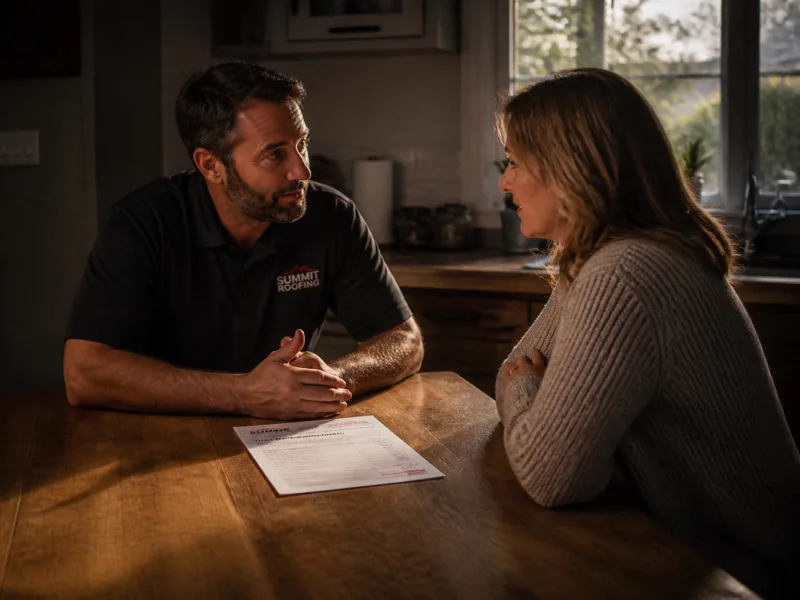
You gave her a solid estimate. You were professional. The price was fair. She said she needed to think about it.
Two days later you called. No answer. You texted. Nothing.
A week after that you found out she went with the other guy. Same materials. Higher price.
That is not a pricing problem. That is a retail problem.
- •She got three quotes and went with the middle price from a company with better reviews
- •She said she was ready and then went silent the moment you sent the contract
- •She called you back six weeks later — after she already hired someone else
- •You followed up once, got no response, and moved on — and later learned she just needed more time
- •She said your price was too high but never told you what "too high" actually meant
- •You ran a great appointment and left feeling good about it and then never heard from her again
If any of those hit — this post is for you.
Here is the thing about the retail roofing customer.
She has no claim number. No adjuster telling her to act. No storm event pushing her toward a decision.
She woke up one morning, looked at her roof, and decided it was time. That decision took months.
And now she is sitting across from you, writing a check out of her own account, with nothing driving her but fear.
If you sell her the same way you sell insurance, you are going to lose her. Every time.
The Retail Sale Is a Different Animal
The insurance customer does not need to be sold on urgency. The storm already did that.
She has a claim number. She has an adjuster who told her the roof needs to come off. She has a check coming that is mostly someone else's money.
The decision to replace the roof was made for her before you ever knocked on her door.
Your job on an insurance job is execution. Show up, scope it right, supplement well, and do quality work.
The retail customer made no such decision. She chose this. She sat with the idea for months, maybe longer, before she called anyone.
She is spending money she earned, saved, and planned for. There is no external event forcing her hand. There is no deadline. There is no adjuster in her corner telling her what needs to happen.
That changes everything about how she buys.
And here is why this matters right now.
The insurance market is tightening. Carriers have moved to percentage-based deductibles — often one to five percent of the home's value. On a $400,000 house, that is a $4,000 to $20,000 deductible.
Roof losses hit $31 billion in 2024, and non-catastrophic wind and hail claims have climbed from 17% to 25% of residential claims since 2022. Carriers are paying less. Homeowners are covering more out of pocket.
Former insurance jobs are quietly becoming retail jobs.
Figure out retail. Or keep losing jobs you cannot explain.
The Mistake Most Roofers Make on the Retail Estimate
Storm-trained roofers do the same thing on every estimate.
They walk the roof. They scope the job. They sit down at the kitchen table and open a proposal that leads with materials, price, and timeline.
On an insurance job, that works. The homeowner already knows she needs a new roof. The claim is approved. She is not evaluating whether to spend the money. That decision is done.
She is evaluating execution. Who is going to handle this correctly and get my claim closed.
On a retail job, that same pitch lands completely wrong.
She did not call you because she had damage. She called you because she started worrying about her roof.
Maybe she noticed some granules in the gutter. Maybe a neighbor got theirs done and it made her start thinking. Maybe she has just owned the house long enough to know it is time.
The need is real. But the urgency is hers alone. And it is fragile.
When you open with price before you have earned trust, you become a number.
And numbers get compared. And the roofer with the best number wins — which means the roofer willing to work the thinnest margin wins.
That is a race you do not want to be in.
The retail customer is not trying to pick a shingle. She is trying to pick a roofer she trusts with her money.
Those are completely different buying decisions. One is a product evaluation. The other is a trust evaluation.
Your roofing sales techniques mean nothing until she trusts you enough to use them.
The Three Fears She Is Weighing Before She Signs
Here is what is actually happening inside her head while you are talking.
She is not thinking about shingles. She is not thinking about your warranty.
She is running a risk calculation.
A $12,000 roof replacement is one of the largest single purchases she will make this year. She has no claim, no adjuster, no external authority telling her this is the right call.
It is just her, her checkbook, and three roofers she found online.
There are three specific fears driving that stall.
Name them. Understand them. Neutralize them. That is the retail close.
- •Fear one: Making the wrong decision. — She does not know roofing. She does not know if your scope is right, if your materials are good, or if the price is fair. She is making a high-stakes decision with no roofing background. The way you remove this fear is not by explaining more about roofing. It is by showing proof that other people in her situation trusted you and it worked out. Reviews. References. A photo of the job you did two streets over. Let other homeowners do the convincing.
- •Fear two: Overpaying. — She is getting three quotes. That is not an insult. That is how a responsible homeowner approaches a $12,000 decision. She does not know if your price is high, low, or fair. The way you handle this is not by defending your price. It is by making your scope so specific and so transparent that she cannot compare your proposal to the next guy's on price alone. Apples to apples only works if the apples are the same. Make sure they are not.
- •Fear three: Being taken advantage of. — Contractor horror stories are everywhere. She has a neighbor who paid a roofer who disappeared. She has seen the news stories. She is wondering if you are going to be on her roof for two days and then ghost her when something goes wrong. You remove this fear by leading with your credentials before you ever open a price book. License. Insurance. How long you have been in business. What happens if there is a problem after the job is done. Spell it out before she has to ask.
She cannot buy until all three fears are quieter than her desire for a new roof.
Your job is to make that happen.
How to Run the Retail Estimate
This is not a script. Scripts break the moment she goes off the path.
This is a framework. Four steps, in order, every time. Run it right and the close becomes the natural next step — not a push.
- 01.
Show up fast.
She called three roofers. The one who responds first gets the conversation first. A 2007 study out of MIT tracked more than 15,000 inbound inquiries across dozens of businesses. Contacting someone within five minutes versus thirty minutes made you 100 times more likely to make contact and 21 times more likely to book the estimate. She is not sitting around waiting for callbacks. She is moving through her list. Set up an automatic text the moment she submits a form or leaves a voicemail. Then call her. Be the first voice she hears. And if you want to understand what happens when homeowners stop leaving voicemails entirely, that post covers it. - 02.
Lead with trust, not materials.
Before you open a proposal, before you talk price, before you say a single word about shingles — establish who you are. How long you have been in business. How many roofs you have done in her neighborhood. Your license and what it means. Your insurance and why it protects her. Three reviews from homeowners who sound like her. A photo of a job you completed two streets away. This takes five minutes. It is the five minutes that determine whether everything else lands. Not sure how many reviews you need before homeowners trust you enough to call? That post answers it directly. - 03.
Present three options, not one.
One price gives her a yes or no decision. Three options give her a choice between good, better, and best. Human psychology does something predictable here — most people choose the middle option. Not because it is the best value. Because it feels safe. Not the cheapest, which signals risk. Not the most expensive, which feels like overkill. Build your tiers around real differences: entry-level shingle versus mid-grade versus premium, with meaningful warranty and material distinctions at each level. Make the tiers real. Then let her choose. You stop being the roofer defending a price and start being the roofer helping her find the right fit. - 04.
Put a monthly payment beside every price.
A $12,000 roof is a big number. Two hundred dollars a month is not. Put the cash price on the left and the financed monthly payment on the right. Every option, every time. You are not pushing financing. You are removing sticker shock. Some homeowners will pay cash anyway. But for the ones who were quietly wondering how they were going to manage this, seeing a monthly number changes the entire conversation. The roof she was stalling on at $12,000 becomes the roof she signs for at $189 a month. Same job. Same margin. Different frame. If she goes quiet the moment you say the total, that pause is the exact cue to bring this up.
The Follow-Up Sequence That Closes Retail Jobs
She did not sign at the appointment. That is not a no.
On an insurance job, the decision timeline is compressed. The claim is open, the adjuster has been out, and she needs to get the work done before the next rain.
On a retail job, there is no external clock.
She is moving at the speed of her own comfort level. Her comfort level goes up every time you show up professionally. It goes down every time you go silent.
Most roofers follow up once. Maybe twice. Then they move on and write her off.
The Brevet Group found that 80% of sales require five or more follow-up touches after the first meeting. But 44% of salespeople quit after the first attempt. Only 8% make it to five.
That gap is where your competition is handing you free money. The gap between where most roofers stop and where most retail jobs actually close.
Here is the sequence. Run it on every retail estimate that does not close at the table.
- 01.
Day one.
Text her within two hours of leaving the appointment. Thank her for her time. Remind her what you discussed. Attach a photo of a recently completed job that looks like her house. Keep it short. You are staying top of mind, not selling. - 02.
Day two.
Call her. Not to push. To serve. Ask if she has any questions about the proposal. Ask if she wants to walk through the options again. If she is comparing quotes, offer to help her understand what to look for. A roofer who helps her evaluate her options is a roofer she trusts. - 03.
Day four.
Send something with proof. A Google review from a homeowner in her neighborhood. A before-and-after photo from a recent job. A note that a spot in your schedule opened up and you wanted to let her know in case timing was a factor. Every touchpoint adds a layer of credibility. - 04.
Day seven.
Call again. By now you know whether she is still deciding or whether she has moved on. If she is still deciding, ask her directly what is holding her back. Not aggressively. Genuinely. Ask: is there something I can clear up or help with? Most homeowners will tell you exactly what the real objection is when you ask that way. And once you know the real objection, you can address it. - 05.
After day seven: weekly.
A short check-in. A relevant photo. A heads-up that your schedule is filling. You are not nagging — you are staying present. The retail customer who goes quiet is not always gone. Sometimes she is just waiting for a reason to say yes. Your job is to keep being that reason.
One thing to remember.
If she tells you she went with someone else, ask why. Not to argue. To learn.
The retail close is a skill that compounds. Every lost job teaches you something the next one benefits from.
The roofers who close more retail jobs are not working better opportunities than you. They just do not quit before the job is done.
►What is the difference between a retail roofing job and an insurance roofing job?
An insurance roofing job starts with a claim. The homeowner had a storm event, filed with their carrier, and an adjuster confirmed the damage. Most of the money comes from the insurance settlement, and there is a built-in deadline pushing the project forward. A retail roofing job has none of that. The homeowner decided on their own that the roof needs attention. No claim, no adjuster, no external deadline. They are spending their own money on a voluntary timeline. The psychology of the buying decision is completely different, and the sales process needs to match it.
►Why do retail roofing customers take longer to decide than insurance customers?
Because nothing is forcing them to move. An insurance customer has a claim to close and a carrier on her timeline. A retail customer made a discretionary decision to spend $9,000 to $15,000 of her own money, and she can put that off until she feels ready. The delay is not disinterest. It is the natural pace of a high-stakes voluntary purchase. A structured follow-up sequence that stays present without pushing is what converts a slow retail decision into a signed contract.
►How do I handle "I want to get another quote" on a retail estimate?
Let her. Do not fight it. Getting multiple quotes is what a responsible homeowner does on a $12,000 decision, and trying to talk her out of it signals desperation. Instead, help her compare. Walk her through what to look for in a proposal — scope specificity, warranty terms, what happens if something goes wrong after the job. When you teach her how to evaluate roofers, you become the standard she measures everyone else against. The roofer who helps her compare is usually the roofer she calls back. That comparison habit is rarely about your price. It is usually a stalling reflex you can turn in your favor.
►What should I say when a retail customer says my price is too high?
First, find out what she is comparing it to. "Too high compared to what?" is the most important question you can ask. If she has a lower quote, ask to see the scope. Nine times out of ten the proposals are not comparing the same work. If your scope is more thorough, show her why that matters. If the scopes are genuinely identical, you have a trust gap, not a price gap. The homeowner who trusts you more will pay more. Go back to your credentials, your reviews, and your track record in her neighborhood before you ever talk about adjusting the number.
►How many times should I follow up on a retail estimate before I move on?
More than you think. The Brevet Group found that 80% of sales require five or more follow-up touches, but most salespeople quit after one or two attempts. For a retail roofing job with no external deadline, follow up on day one, day two, day four, day seven, and then weekly after that. If she has not responded after four to five weeks of consistent, professional outreach, you can scale back. But do not disappear after one unanswered call. The retail job that closes on day 21 pays the same as the one that closes at the table.
The close is your job. Getting her to call you in the first place is ours. That is exactly what the Search-to-Booked Roofing System does — puts your company in front of retail homeowners who are already searching, already comparing, and already ready to call someone. Make sure that someone is you.