
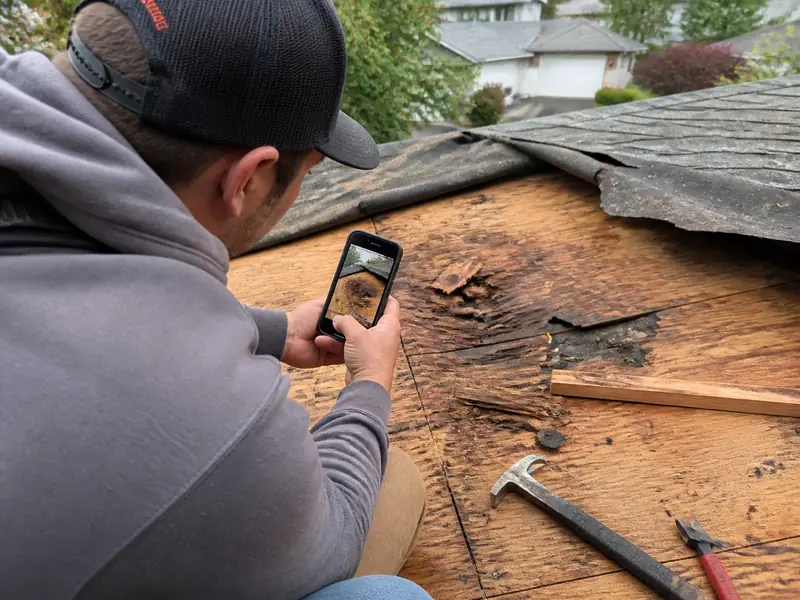
The tear off starts. The felt comes up. And there it is. Decking so soft your boot goes through it.
None of that was on the adjuster's estimate. Six squares of shingles and some flashing. That is what the report said. Written from a drone photo and a fifteen minute walk of the roof.
Now you have a decision. Write it up and submit it. Or shrug, eat the cost, and finish the job for less than it is worth.
Here is what happens depending on which one you pick:
- •You found rotted decking or hidden flashing damage during tear off and ate the cost instead of writing it up
- •You called the adjuster yourself and tried to argue for more money over the phone
- •You submitted photos with no measurements or code citations and got the supplement denied
- •You waited until the job was finished to ask for more, and the adjuster had already closed the file
- •You have never actually seen an approved supplement, so you would not know what one looks like
Getting the supplement approved is not a negotiation. It is a paperwork problem. And most roofers lose it before they even try.
This only applies to insurance work. If she is paying out of pocket, the whole conversation is different.
You Are Not Negotiating. You Are Documenting.
You cannot negotiate a claim. Not legally. In 2024, the Texas Supreme Court ruled that a roofing contractor without an adjuster's license cannot negotiate an insurance settlement on a homeowner's behalf, even when the homeowner's contract tries to authorize it. The court noted that roughly 40 other states have similar laws on the books.
That is not a technicality. It is the whole reason so many roofers get this wrong.
They think winning the supplement means getting on the phone and making a case. Pushing back. Talking the adjuster up on price the way you would talk a homeowner into a better shingle.
It does not work that way. And trying it is how you end up on the wrong side of a licensing complaint instead of a bigger check.
Here is what actually happens. You do not negotiate the number. You build the record that makes the number obvious.
Every supplement that gets approved without a fight has the same thing in common. It was documented so clearly that arguing with it would have taken more effort than approving it.
That is the entire skill. Not persuasion. Proof.
What the First Number Almost Always Misses
The first number on that estimate is not wrong on purpose. It is wrong because of how it was written.
A lot of these estimates now start from an aerial measurement report before anyone climbs a ladder. Square footage, pitch, and facets, pulled from a satellite image or a drone pass. Accurate for square footage. Blind to everything a camera three hundred feet up cannot see.
Here is what that photo will never show you:
- •Decking that has gone soft from years of slow leaks, not the storm itself
- •Code-required upgrades your local building department mandates the moment a permit is pulled, things like drip edge or updated flashing
- •Flashing damage hidden behind siding, around a chimney, or under a satellite dish nobody ever moved
- •Ventilation components that fail the moment the old roof comes off and someone can actually see them
None of that shows up until the felt is off and you are standing on the deck. By then the adjuster is gone. The estimate is written. The number is already sitting in the homeowner's inbox.
That gap between what the aerial report saw and what your crew found is not something to argue about. It is a supplement to build.
The Documentation That Turns a Missed Item Into an Approved Supplement
A supplement does not get approved because you asked nicely. It gets approved because you made denial harder than approval.
Here is what that actually takes.
- 01.
Photograph it before you touch it.
The soft decking, the hidden flashing, the rot behind the chimney flashing. Wide shot for context, close shot for detail, before a single piece gets removed or replaced. - 02.
Measure it and write it down.
Square footage of decking replaced. Linear footage of flashing. Not "some" or "a lot." Numbers an adjuster can put directly into their own worksheet. - 03.
Name the code section, not just "code."
Pull the specific requirement from your local building department, the drip edge mandate, the ice and water shield zone, whatever applies. A citation is verifiable. "It's code" is an opinion. - 04.
Submit it while the job is still open.
Same week, not same month. A supplement request tied to a job in progress reads as documentation. One filed after completion reads as an afterthought. - 05.
Send it to the adjuster of record, in writing.
Photos and measurements attached, one item per line. Not a phone call. Not a text. A written record either gets approved or gets a written reason why not, and both of those are useful.
That packet is the entire argument. Nobody on the other end has to take your word for anything. They just have to look at what you already proved.
The Roofers Who Eat the Difference Are the Ones Who Accepted the First Number
Every roofer has done the same job on paper. Same shingles. Same crew. Same signed insurance contract.
The difference between them shows up on the final invoice.
One roofer found the soft decking, photographed it, measured it, cited the code, and submitted a supplement the same week. His invoice matched what the job actually took to do right. He got paid for the extra plywood and the flashing nobody saw from a drone.
The other roofer found the same soft decking. Replaced it anyway, because leaving it would have been worse than eating the cost. Wrote it off as the price of doing business.
Same discovery. Same extra material. Same extra labor. One of them got paid for it.
That is not bad luck. That is the difference between building a file and not building one.
You already know what she needs to hear before she signs. The same instinct that makes you tell her the truth about the first check is what makes you document instead of argue once the tear off starts.
The number on the adjuster's report was never the final word. It was just the first draft. You write the rest of it with a camera and a tape measure, not a phone call.
►What is an insurance supplement in roofing?
A supplement is a request for additional insurance funds to cover damage or code-required work the original adjuster estimate left out. It gets submitted after your crew documents something the first inspection missed, usually decking rot, hidden flashing damage, or a code upgrade. Approved supplements get added to the existing claim, not negotiated as a separate matter.
►Can a roofer negotiate directly with an insurance adjuster?
No, not in most states. Negotiating a settlement on a homeowner's behalf is public adjusting, and that requires a license you almost certainly do not have. What you can do is document damage, provide measurements, and submit a written supplement request. That is not negotiation. That is scope correction.
►What items get missed most often on the first adjuster estimate?
Anything a camera cannot see from the air. Rotted decking, flashing damage hidden behind siding or a chimney, and code-required upgrades your local building department mandates once a permit is pulled. None of it shows up until the old roof is off and your crew is standing on the deck.
►How long does a roofing insurance supplement take to get approved?
It depends on the insurer, but a clean, well-documented supplement submitted while the job is still open moves faster than one filed after completion. Photos, measurements, and code citations attached in writing give the adjuster everything needed to approve it without a back and forth.
You already know how to build the file now. The other half of the job is having enough storm damage calls coming in to make it worth building.