
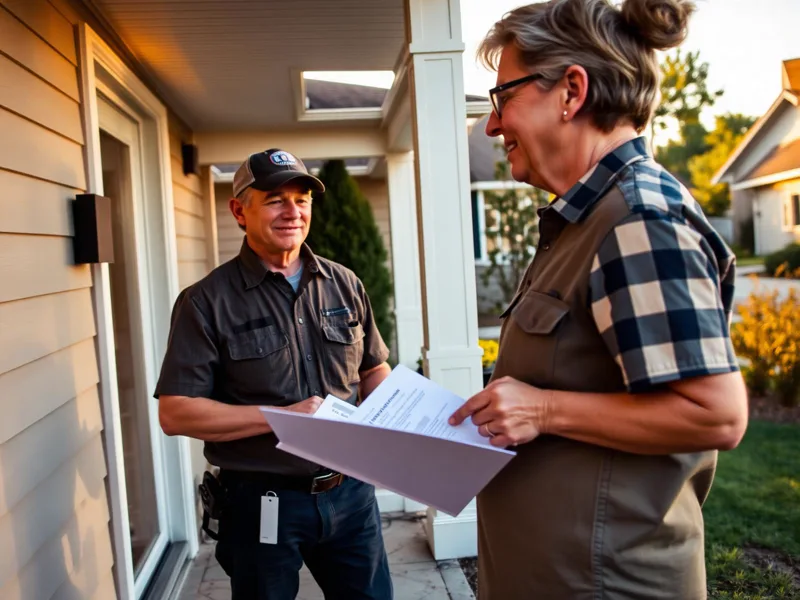
She had a storm roll through her neighborhood last Tuesday.
By Wednesday she filed a claim. By Thursday she had an adjuster scheduled. By Friday she called three roofers.
You were one of them.
One roofer never called back. One showed up, walked the roof for eight minutes, handed her a number, and said call me when you're ready. You showed up, did the same thing, and now you are waiting on a text that is not coming.
The roofer who got signed did something different.
Not a better pitch. Not a lower price. Something that had nothing to do with roofing at all.
Here is what he understood that you need to know right now:
- •You left a solid estimate and never heard back
- •She seemed interested at the appointment but went cold after the adjuster came
- •You followed up once, maybe twice, then moved on
- •She signed with someone else at a higher price than you quoted
- •You knocked the neighborhood after a storm and got doors closed before you finished your first sentence
Insurance roofing is not a harder sale. It is a different sale. And the roofers who treat it like retail keep losing jobs they should have won.
She Is Not Buying a Roof. She Is Buying Certainty.
She does not care about your shingle brand right now.
She is not comparing your warranty to the guy down the street. She is not thinking about architectural versus three-tab.
She is sitting at her kitchen table with an insurance policy she does not fully understand, a storm that hit without warning, and a five-figure decision she has never made before.
Here is what is actually going through her head:
- •Is this contractor going to take advantage of me?
- •What if the insurance company does not pay enough?
- •What if I end up with a bill I cannot cover?
- •What if they start the job and disappear?
- •What if I sign something I should not have signed?
That fear stack is not irrational. It is the reason she is not calling you back.
Losses feel roughly twice as painful as equivalent gains feel good. She is not weighing the upside of a new roof. She is bracing against everything that could go wrong.
A homeowner in that mental state does not respond to confidence. She does not respond to a polished pitch.
She responds to one thing.
A roofer who already knows what she is afraid of and addresses it before she has to ask.
The roofer who walked her through her fears before she voiced them did not just build rapport. He made every other roofer look like they were not paying attention.
That is the whole game on an insurance job. Not the close. The certainty.
When you sit down with a storm damage homeowner, your first job is not to sell a roof. It is to reduce her fear enough that she can make a decision.
Name what she is worried about. Tell her what the process looks like. Tell her what could go wrong and how you handle it.
Do that, and the sale takes care of itself.
And if you want to know why a missed call on a storm damage lead costs you more than any other job type — that fear stack is exactly the reason. She is not leaving a voicemail. She is already calling the next roofer.
The First Check Is Going to Scare Her. Tell Her That Up Front.
Here is the moment that kills more insurance roofing jobs than any objection a homeowner ever voices.
The adjuster approves the claim. The insurance company sends the first check. She looks at the number and thinks something has gone terribly wrong.
Her roof costs $18,000 to replace. The check in her hand is for $9,400.
She does not call you to ask what happened. She calls her cousin. Her cousin says she got lowballed. Her neighbor says the contractor is probably scamming her. She starts Googling.
By the time she talks to you again — if she talks to you again — the job is gone.
This does not have to happen.
A five-minute conversation at the estimate prevents all of it.
Most insurance policies pay out storm damage claims in two checks — not one.
The first check covers the actual cash value of her roof. What it is worth today, after accounting for age and condition. On a fifteen-year-old roof, that depreciation is significant. The number is going to look small.
That is not a mistake. That is how the policy works.
The second check — the recoverable depreciation — gets released after the work is completed and documented. That is when the numbers add up to what she was expecting.
The National Association of Insurance Commissioners puts it plainly: two neighbors with identical storm damage can receive very different first checks depending on whether their policy pays replacement cost value or actual cash value. On an older roof, that first payout can look like a fraction of the job cost.
That is not fraud. That is the policy she has been paying for.
Tell her this at the estimate. Show her the two-check structure on paper. Tell her the first number is going to look wrong — and that it is completely normal.
When that check arrives exactly as you described, you are no longer just a roofer.
You are the one person in this entire process who told her the truth before she needed to hear it.
Be There When the Adjuster Shows Up.
Most roofers find out what the adjuster said after the fact.
The homeowner calls. Reads them a number off a piece of paper. Now you are negotiating against a scope you had no part in building.
Line items are missing. Code upgrades are not on there. The decking allowance is wrong.
And she has no idea why any of it matters.
The roofers who win insurance jobs consistently do not let that happen.
They are on the roof when the adjuster is on the roof.
This is the single highest-leverage move in insurance roofing. Not the pitch. Not the follow-up cadence.
Being present at the adjuster inspection is where the job gets won or lost. And most roofers are not there.
An adjuster spends twenty to forty minutes on a roof that takes you two hours to scope properly. They are working from a checklist, moving fast, writing what they can document in the time they have.
They are not trying to shortchange the homeowner. They are trying to close a file.
Those are not the same thing.
When you are there, you walk the roof with them. You point to the hail strikes on the north slope they have not reached yet. You flag the damaged drip edge, the compromised pipe boots, the decking that will not show until tear-off.
You ask questions. Not argue. Not demand. Just ask.
"What do you think of this area here?" goes a long way.
Now — stay in your lane. That part matters just as much.
She filed the claim. She owns the policy. She is the one talking to her insurance company. Your job is to document damage and answer scope questions. That is it.
Never ask to see her policy. Never tell her what her policy covers. Never discourage her from talking directly to her insurer.
Stay in your lane and the adjuster visit becomes the moment the job gets built right from the start.
Miss it and you are spending the next three weeks supplementing a scope you had no hand in writing — if she even calls you back. Getting that supplement approved later takes its own kind of proof, and most roofers never build the file that makes it easy.
Anyone Who Offers to Waive Her Deductible Is Asking Her to Commit Fraud.
She has been warned about you.
Not you specifically. But someone who looks exactly like you showed up at her door after the last storm in her neighborhood. And the one before that.
The FTC has a consumer alert about it. Her insurance company sent her an email about it. Her neighbor shared a news story about it on Facebook.
Contractor fraud complaints rose 38% from 2023 to 2025, according to the National Insurance Crime Bureau. After every major storm, chasers flood those neighborhoods with promises they have no intention of keeping.
She knows the warning signs. She has been told to look for them.
Door knocking. Pressure to sign the same day. Asking to see her insurance documents before she has agreed to anything.
And the biggest red flag of all.
Offering to waive her deductible.
In a minimum of 28 states, waiving or rebating a homeowner's deductible is illegal. Not a gray area. A crime — for the contractor and in many cases for the homeowner who accepts it.
It is also precisely the tactic storm chasers use to close fast.
So when she asks whether you can work around the deductible — and some will ask — do not dodge it. Use it.
That answer does two things at once.
It disqualifies every storm chaser who made her the opposite offer. And it tells her — in plain language she can verify — that you are the roofer who plays by the rules.
The FTC's consumer guidance on avoiding contractor scams after storms lists deductible waiving as one of the primary red flags homeowners should watch for.
When you are the one telling her that, you are not just a contractor.
You are the person who helped her protect herself.
That is a different category entirely.
If the deductible is a genuine hardship, the conversation is about financing. There are products built specifically for this that keep everything legal and keep her job moving forward. That is the path. Not pretending the deductible does not exist.
Be the roofer who told her the truth. In a neighborhood full of storm chasers, that is the easiest way to be the most trustworthy person she talked to all week.
The Follow-Up Cadence That Wins Insurance Jobs.
Insurance roofing does not move on a retail timeline.
On a retail job, she calls, gets estimates, makes a decision. Days, maybe a week.
On an insurance job, she is waiting on the adjuster report. Then the insurer's decision. Then the first check. Then she has to figure out what the first check means. Then the second check.
The average roof insurance claim runs thirty to forty-five days from filing to payout.
That is not a slow lead. That is a different timeline.
And the roofer who treats it like a slow retail job follows up twice and disappears. The job goes to whoever was still there when she was ready to decide.
Here is the reality.
Eighty percent of sales require five or more follow-up contacts. Forty-four percent of roofers quit after one attempt. Only two percent of jobs close on first contact.
Your competition is gone by day three. You just have to still be there on day thirty.
On most crews you are doing this yourself — between jobs, on the way to a site, at the end of a long day. That is exactly why a set cadence works better than winging it.
- 01.
Day 1 — Same day as the estimate, or next morning.
Do not just check in. Send her a written summary of what you found, what you expect the adjuster to document, and what the two-check process will look like for her. Give her something she can refer back to. - 02.
Day 2 — Short touchpoint.
Any questions after looking everything over? Has she scheduled the adjuster yet? Two sentences. You are staying present, not pressuring. - 03.
Day 4 — Check in on the adjuster visit.
If it already happened, ask how it went and whether she has questions about the scope. If it has not happened yet, remind her you are available to be there. - 04.
Day 7 — Follow up on the adjuster report.
This is your most valuable touchpoint. The numbers look off. The scope seems incomplete. She does not know what to do next. Be the person who helps her read that report and the job is yours. - 05.
After day 7 — Weekly until she is ready.
One useful question or piece of information per week. Not noise. Not pressure. Just proof that you are still there.
Every follow-up has a reason. Not checking in. Checking on something specific she is actually waiting on.
The roofer who ghosts her after the estimate is gone. The roofer who calls three times in the first week with nothing new to say is annoying.
The roofer who shows up at the right moment with the right information is the one she calls when she is finally ready.
And if you want to understand why reviews are the reason she calls one roofer and not another before any of this even starts — that is worth knowing too.
Stay in the process. That is the close.
►What do homeowners with storm damage actually want from a roofer?
Certainty more than price. She is navigating a process she has never been through, making a five-figure decision under stress, and trying to figure out who she can trust. The roofer who explains what is coming before she has to ask gives her what no pitch can. Be that person and the price conversation rarely becomes the obstacle.
►Should I be there when the insurance adjuster inspects the roof?
Yes. Every time you can make it happen. An adjuster may spend twenty to forty minutes on a roof that takes an experienced contractor two hours to scope. When you are there you surface damage and code-required items they might otherwise miss, not by arguing, but by asking questions and presenting documentation. Stay in your lane: document damage, answer scope questions, and never position yourself as interpreting her policy or discouraging her from talking directly to her insurer.
►How do I explain ACV and depreciation without losing the homeowner?
Do it before the first check arrives, not after. Walk her through the two-check structure at the estimate. Tell her the first check covers the depreciated value of her roof and is going to look smaller than she expects. Tell her the second check releases once the work is documented and complete. When that first check arrives exactly as you described, you become the one person in the entire process who told her the truth before she needed it.
►How many times should I follow up on a storm damage estimate?
More than you think. Eighty percent of sales require five or more follow-up contacts and most roofers quit after one or two. On an insurance job she is inside a thirty-to-forty-five-day process. Run the Day 1, Day 2, Day 4, Day 7, then weekly cadence with every contact tied to something specific she is actually waiting on. Not checking in. Checking on something real. The roofers who win insurance jobs are simply the ones who are still there when she is finally ready to move.
You now know what she is afraid of, what to say at the estimate, and how to stay in the process until she is ready to sign. The part that gets her to call you first — that is what the Search-to-Booked Roofing System™ is built for.