
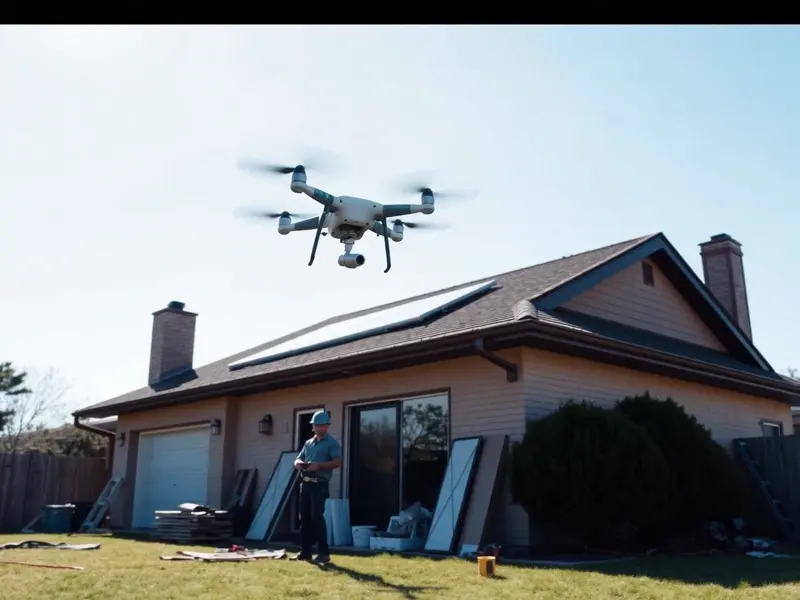
Your drone comes out for storm jobs. Big hail. Big claim. Every other roof on your schedule gets nothing. No before shot. No after shot. Nothing in the file when a homeowner calls back eight months later asking why her flashing looks different than she remembers.
You already know the moments this catches you.
- •A homeowner disputes the scope six months in and you have no record of what the roof looked like on day one.
- •An adjuster questions the damage and your only evidence is a handful of ground-level phone photos.
- •A callback comes in on a job from last spring and nobody on the crew remembers which house it was.
- •A competitor's crew damages a neighboring roof and points at yours, with nothing on file to prove otherwise.
- •Your closer sells the next house on the block with nothing to show but a verbal walk-around.
Why This Costs You More Than You Think
A scope dispute without proof does not end in an apology. It ends in a discount, a redo, or a canceled final payment. You eat the cost because you have nothing to point to.
An insurance claim without documentation moves slower. Adjusters approve what they can see. A ground-level phone photo from six feet away does not show hail scatter on a low-slope section. A drone pass does, and it gives you more to work with when the first number is never the final one.
A callback with no file costs you time before it costs you money. Someone has to remember the job, find the invoice, guess at what was done. That is thirty minutes you are not roofing.
And the moments you cannot document are the moments someone else gets to write the story. A homeowner. An adjuster. A competitor. Whoever has the photo controls the version of events that gets believed.
The System: Fly Every Roof, Every Time
Storm jobs get the drone because someone remembers to grab it. Every other roof does not, because nobody built a rule that says it has to happen. That is not a discipline problem. That is a systems problem.
The fix is not "fly more roofs." The fix is one line in your job checklist: no roof closes out without a flight. Storm claim, retail reroof, single shingle repair. Doesn't matter. If a truck rolls, the drone rolls.
That is the same logic behind why the same four questions keep coming up: if it happens more than once, it needs a checklist. A drone flight on every job is not a nice-to-have. It is a checklist item with an owner.
This does not need a full-time drone operator. It needs one crew lead trained on a five-minute flight and one shared folder everyone on the team knows how to use.
The Four-Angle Standard
- 01.
Fly Before Anyone Touches the Roof
Capture it exactly as you found it. Four angles: north, south, east, west. This is your undisputed starting point. Nobody argues with footage taken before your crew arrived. - 02.
Fly Again After Tear-Off
This is the pass almost everyone skips, and it is the one that matters most on a claim. Once the old material is off, decking condition and hidden damage are visible for the first time. This footage is what turns a supplement request into an approved one. - 03.
Fly the Finished Roof
Same four angles as step one. This is your proof of workmanship. Here is what we found, here is what we did, here is what we left behind. - 04.
File It by Job Number, Same Day
Footage sitting on somebody's phone for two weeks might as well not exist. One shared folder. One naming rule: job number, then date. Ten seconds to upload, there the day you need it.
Where the File Pays You Back
You built this system so the footage is there before you need it. Here is where it earns its keep.
- •The disputed scope. — A homeowner questions what was replaced. You pull the before-and-after and the conversation ends in two minutes.
- •The stalled claim. — An adjuster is not seeing enough damage to approve the number. Tear-off footage shows what the shingles were hiding.
- •The warranty callback. — A leak shows up eighteen months later. The finished-roof footage shows exactly what your crew did and did not touch.
- •The blame game. — A neighbor claims your crew damaged their property. Your flight logs and footage put a date and an angle on what actually happened.
None of this requires a new hire or a new tool budget. It requires the same discipline as any other checklist item that runs on its own once you stop being the one holding it together.
►Do I need a drone license to do this?
If you are flying for your business, yes. The FAA requires a Remote Pilot Certificate under Part 107. You take the knowledge test once, then complete free online recurrent training every 24 months to stay current.
►How long should I keep the footage?
At minimum, as long as your workmanship warranty runs. Two years is a safe floor for most roofers. Storage is cheap. The footage you delete is the one you need six months later.
►Does a small repair really need a full flight?
Yes, but not a full production. A two-minute pass with four angles takes less time than writing the invoice. The habit only works if there are no exceptions.
►What if nobody on my crew knows how to fly a drone?
One person can learn a basic four-angle flight in an afternoon. This is not aerial photography. It is documentation. Nobody is chasing a cinematic shot.
You just built one system that protects every job whether you are on site or not. Your marketing should run the same way, a system working in the background instead of one more thing on your list.