
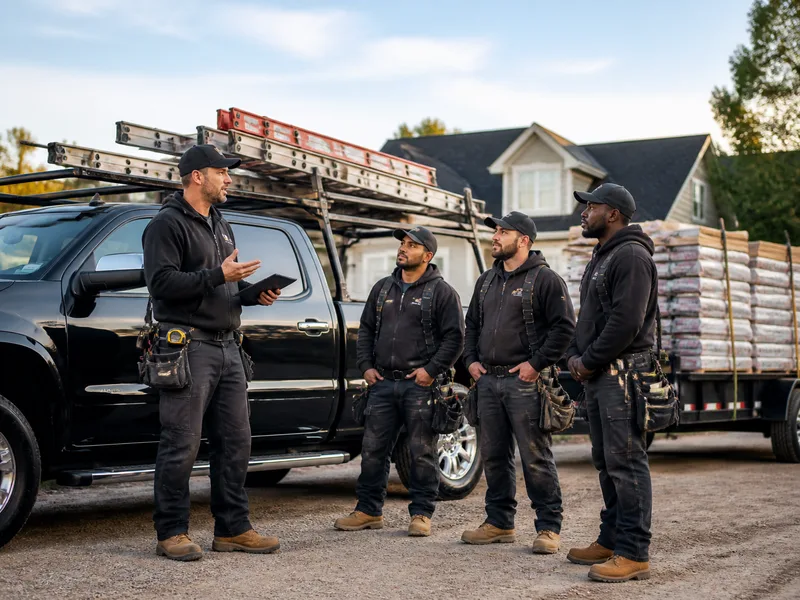
Your crew shows up, grabs tools, and gets on the roof. Nobody talks about what went wrong yesterday. Nobody confirms what's actually on the truck. Nobody says out loud who is doing what today.
That gap costs you a callback three weeks from now. By then nobody remembers why.
If any of this sounds like your Monday morning, you already know the gap I am talking about:
- •A crew starts tear off before anyone mentions the leak call from a job three streets over yesterday
- •Nobody says out loud that the ridge caps never made it onto the truck until someone is already on the roof
- •Two guys assume the other one is handling the chimney flashing. Neither one does.
- •A crew lead notices something off about yesterday's work but does not think it is his place to bring it up
- •The same mistake happens twice because nobody talked about the first one
Fifteen minutes before anyone touches a ladder fixes this. Not a meeting. Not paperwork. Four questions, same order, every morning.
Why the Cost of Skipping This Shows Up Three Weeks Later, Not Today
Skipping the huddle does not cost you today. Today the crew hits the roof twenty minutes faster. That feels like a win.
The cost shows up three weeks later, when a homeowner calls about a soft spot near the chimney. Nobody remembers if that flashing detail got flagged. Nobody remembers if the crew lead had a concern he never mentioned out loud. By the time the callback comes in, the job is a memory, not a conversation.
A callback is not just a truck roll and a morning of labor you do not get to bill for. It is a homeowner who now has a reason to wonder what else got missed. Some of them tell you. Most of them just leave a review.
You are the bottleneck in your own business when every quality catch depends on you personally walking every job. The huddle is not about you catching more. It is about building a habit where your crew catches it before it ever reaches you.
What Happened Yesterday That Needs a Second Look?
Not a debrief. Not a blame session. One sentence per job. Did anything look off. Did a homeowner say anything. Did the crew improvise around a detail because the plan did not match the roof.
Nothing to report, say so and move on. Something to report, it gets a name and a next step before the huddle ends.
What's Different About Today's Job That the Crew Hasn't Seen Yet?
Every job has something the crew has not run into before. A dog in the yard. An HOA rule about tarps in the driveway. A homeowner who works nights and is asleep until noon. A section of decking the last inspection flagged.
Say it once, out loud, before anyone is on a ladder. This is the piece that usually lives in your head or in a text thread nobody reread.
Who Is Doing What Today?
Not the job assignment. That already happened. This is the role on site. Who is running the ridge. Who is handling flashing. Who is checking the details nobody assigned out loud.
Two guys assuming the other one has it is how a chimney flashing detail gets missed on a finished roof.
What Do We Check Before We Leave?
This is the question that actually prevents the callback. Not what did we install. What do we check before the truck pulls away. Nail pattern in the valleys. Flashing sealed at every penetration. Photos of anything that could come up later.
Four questions. Ninety seconds each if you keep it moving. Six minutes before anyone touches a ladder.
How to Run It in 15 Minutes Without It Becoming a Meeting Nobody Wants
A meeting nobody wants is long, unstructured, and repeats itself. This is fifteen minutes, same shape, every day.
- 01.
Same time, same place, before the trucks leave.
Not after the first job starts. Once it moves, it stops happening. - 02.
One person leads it.
If you are not first on site every morning, it is not you. It is the foreman or lead installer running that crew. - 03.
Same four questions, same order, no exceptions.
This is not the place to solve a scheduling fight from two jobs ago or debate a customer's change order. Park it. Handle it after. - 04.
Anything with a follow up gets written down.
One line. Who owns it, what happens next. Not a report. A log anyone can check later.
Four questions, one leader, one line for anything that needs a follow up. Fifteen minutes, most days closer to ten.
What Changes After 30 Days
Thirty days of the same four questions and the pattern shifts.
You stop hearing about problems from the homeowner first. The crew mentions the soft spot before it becomes a callback, not after.
Your crew lead starts naming things unprompted. Not because you asked twice. Because the huddle made it normal to say something is off instead of hoping it holds.
The callback rate does not drop because you started inspecting more. It drops because the crew started catching things you never would have seen anyway.
And the huddle stops feeling like a task. It becomes the fifteen minutes that used to cost you a callback three weeks later.
Frequently Asked Questions
►Who leads the huddle if I am not on site every morning?
Your foreman or lead installer. The huddle needs an owner who is there every day, not you dialing in when you can.
►What if my crew pushes back on adding a meeting?
It is not a meeting. It is four questions and fifteen minutes. Most resistance disappears the first time the huddle catches something before it becomes a callback.
►Does this replace a toolbox talk?
No. A toolbox talk covers safety for that day's specific hazards. This covers quality and coordination. Some crews run both back to back in under twenty minutes total.
►What if there is nothing to report on a given day?
Say so and move on. Nothing to report is still information. Skipping the question because it is usually quiet is how the one day it is not quiet gets missed.
The huddle works because problems get caught early instead of found out about later. Marketing runs on the same principle. Right now, getting found and getting called is probably something you check on when you remember to, not something with a daily owner. The Search-to-Booked System is that daily owner. It runs Found, Called, and Booked so marketing stops being the thing you catch three weeks late.