
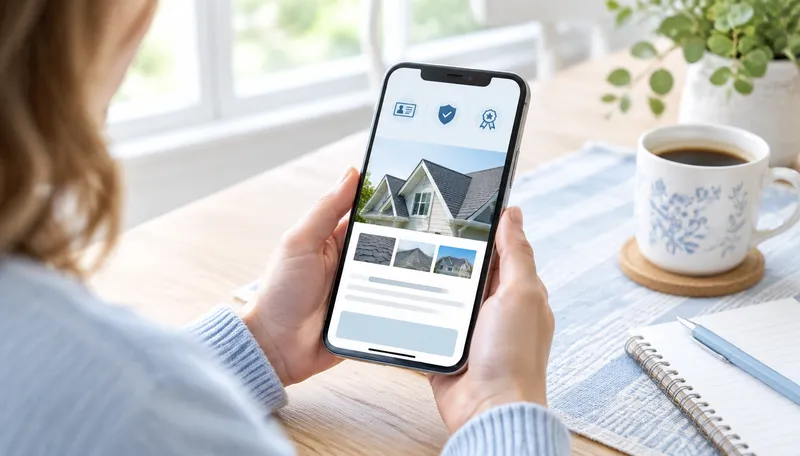
She is at the kitchen table with her phone and a stain on the ceiling. She does not read your About page, because she is most likely scanning for three things: licensed, insured, warrantied. A roofing website trust bar answers all three before she picks up the phone.
Not a gallery. Not a slogan. Proof, in the first place she looks.
Right now, that proof is probably hard to find. Here is what is likely on your site today:
- •Your license number, if your state issues one, lives in the footer in small gray type.
- •Your insurance is a PDF nobody can find.
- •The warranty is described in the estimate and nowhere else.
- •Nothing on the first screen says who stands behind the work.
- •A cheaper roofer looks just as legitimate on the page.
She is not being picky. She is hiring a stranger to work above her family, and she cannot see what stands behind your name. This post shows what to put in the bar, where it goes, how to show proof without handing over private documents and what never to claim.
What She Checks Before She Calls
She is not hunting for your best-looking project. She is trying to rule you out. Licensed, insured and warrantied are the questions she is likely to ask to decide whether you are safe to put on the roof.
Licensing is a good example. The California Contractors State License Board tells consumers that seeing a license number does not necessarily mean the license is valid, and it sends them to look it up. A homeowner who knows that will check you.
Insurance gets the same treatment. The same board lists workers' compensation coverage among the things to check, and says California contractors with employees must carry it. So "are you insured?" is a fair question for her to ask.
Your own workmanship warranty is hard for her to check, which is why it needs plain words on the page and not a PDF behind a download.
What Goes in the Trust Bar
Keep it to a short row of items she can read in a few seconds. Each one needs a plain label and one line of proof.
- •License. — Your license number and the name of the board that issued it, so she can look you up. Show it only where your state issues one to roofers.
- •Insurance. — A plain statement of the coverage you actually carry, such as general liability, and workers' compensation if you have employees, with a way to request the certificate.
- •Warranty. — If you offer a written workmanship warranty, state it in one sentence, with the number of years and what it covers. If you do not have one in writing yet, write it before you publish this line.
- •Manufacturer certifications. — Only the ones you actually hold, named exactly as the manufacturer names them.
- •Review count. — Your real count and rating, from the place she can verify it.
The license line depends on where you work. Where your state licenses roofers, as California does through its contractor board, the number belongs in the bar.
Texas is different: a 2025 House bill analysis stated that Texas did not then require a state-issued license for reroofing contractors. Check your own state and local rules.
If your state does not license you, do not invent a badge to fill the gap. Put the insurance you carry and your written warranty first, and let those carry the weight.
Reviews are the fifth item because they are the proof she can check without you. If you are not sure how many you need, how many reviews a roofer needs to win the job covers it.
Where It Goes on the Page
The footer is the wrong home. By the time she scrolls there, she may already be gone.
Put the bar directly under the headline on the home page, on the first screen of her phone. Then repeat it on every service page and near the estimate form, so it follows her to the moment she decides. Keep the longer version on the About page.
- 01.
Home page.
Directly under the headline, before the first photo. - 02.
Service pages.
Just above the call button or form. - 03.
Estimate form.
One line beside the submit button that names the license (where your state issues one), insurance and warranty. - 04.
About page.
The longer version, with the detail she wants after she is already interested.
Make it text she can read, not an image of badges. Text loads fast, works with a screen reader and gives search engines something to read. It also matches what the roofing website is already saying about you.
How to Show Proof Without Sharing Private Documents
You do not need to post your policy. A full insurance certificate can carry details about your business that you would rather keep off the open web.
Show the fact, then make the proof one step away.
- •Name the coverage. — Say what you carry in plain words, such as general liability and, if you have employees, workers' compensation.
- •Offer the certificate. — Add a short line such as "Certificate of insurance sent the same day you ask." Then do it.
- •Point to the lookup. — If your state licenses roofers, show your license number and link to the state lookup, so she verifies you on the board's own site.
- •Print the warranty. — Put the terms in the page text, not in a download. Offer the signed copy with the estimate.
The point is control. She gets an answer in seconds, and you decide which document leaves the building. The same logic applies to the warranty, which belongs in plain words as part of an offer that gives her a reason to call.
Send the real certificate as soon as she asks, and always before work starts. A slow reply to a simple request tells her how you will handle the job.
What Not to Claim
A trust bar only works if every line in it is true and checkable. One false badge costs you the whole bar.
- •Certifications you do not hold. — If you are unsure of the exact program name, leave it out.
- •A license number that is expired, suspended or not yours. — She will look it up, and the board will tell her.
- •Coverage you do not carry. — Name only the insurance you actually hold, and update the bar if a policy lapses.
- •Warranty terms you have not put in writing. — If it is not in writing, she cannot check it and you cannot prove it.
- •Another state's rule as if it were yours. — Do not present a license, insurance or bonding requirement as applying where you work when it comes from somewhere else.
Some claims are restricted by law. The California board's industry bulletin says contractors there are not allowed to advertise that they are bonded. Other states may treat bonding claims differently, so check yours before a bond line goes on a badge strip.
Check your own state board's advertising rules before you publish the bar. If you cannot find the answer, leave the line off until you can.
►What should a roofing website show to build trust?
Show your license number where your state issues one, a plain statement of your insurance, your workmanship warranty in one sentence, any manufacturer certifications you actually hold and your real review count. Put them together in a short bar near the top of the page.
►Should I post my license number on my website?
Yes, where your state licenses roofers. The California board, for example, requires contractors there to include their license number on advertisements. Check whether your own state counts a website, and if your state does not license roofers, do not invent a badge.
►Do I need to show proof of insurance online?
You do not need to post the policy itself. State the coverage in plain words and offer the certificate on request. That answers her question without putting your paperwork on the open web.
►How do I explain my roofing warranty on my website?
If you offer a written warranty, write it in the page text, not in a PDF. Give the number of years, say what it covers and say who stands behind it. Then offer the signed copy with the estimate.
The Search-to-Booked Roofing System™ makes you findable and trusted before the homeowner ever calls, so she sees proof before she compares. The Built-to-Book Roofing Website, which starts at Pipeline, puts that proof in the first screen.