
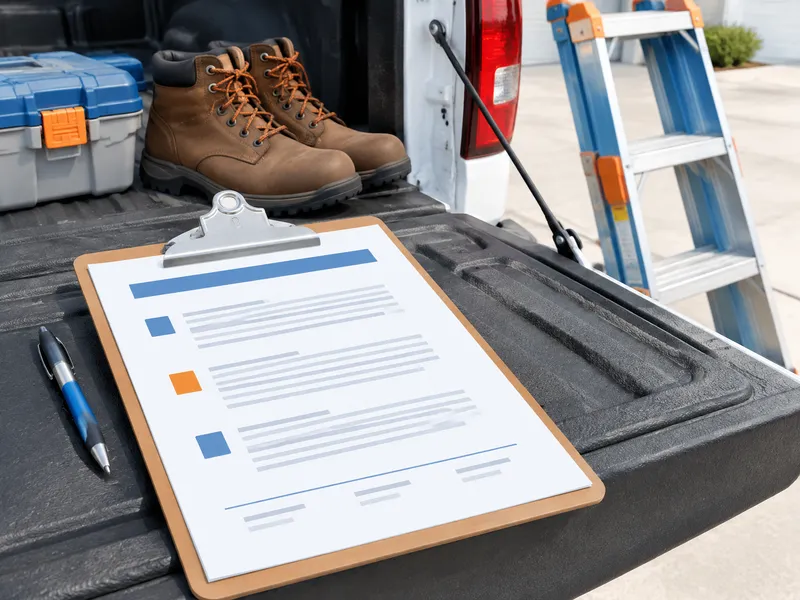
The crew pulls up to a sold job and the homeowner meets them in the driveway. She says the plan on the truck is not the plan she agreed to. Nobody on the crew was at her kitchen table, so nobody can say who is right.
That gap between the signature and the first shingle is where a lot of jobs go wrong. A roofing production handoff packet closes it. It is one page, filled in once, that travels with the job from the sale to the last bundle.
Here is what the gap looks like in your week:
- •The sold scope lives in the salesman's head, and he is on another driveway.
- •Your foreman calls from the curb to ask where the gate code is.
- •Materials get ordered from a photo of a handwritten note.
- •A change agreed to at the kitchen table never makes it to the truck.
Four problems. One cause. The job changed hands and nothing traveled with it.
Where the Promise Gets Lost
A sold job has two owners. The person who sold it knows what was promised. The crew that builds it knows how to build.
Between them sits a phone call, a text and a memory. The memory is the weak part.
He sold four jobs this week, so by Thursday Tuesday's kitchen table is fuzzy. He did not forget on purpose. He had nowhere to put what he heard.
Think about what a homeowner says at the table: keep the dog out of the side yard, start after nine, save the edging by the back door.
None of it is scope, so none of it is on the contract. All of it is on her mind when the truck pulls in.
A signed contract settles the scope. It does not carry the small promises. One person should sign every contract so the paperwork stays consistent, and the packet picks up where the contract stops.
Promises get lost in three places:
- •In his head. — The salesman remembers the big items and loses the small ones.
- •In a text thread. — The detail sits in a message from nine days ago, between a photo of a dumpster and a thumbs up.
- •In a verbal change. — The homeowner asks, he says sure, and it never reaches the person holding the nail gun.
The fix is not a better memory. It is a page.
What Goes on the Page
One page, front only, six blocks in this order. If it spills onto a second page, you are writing a contract, not a handoff.
- 01.
Scope.
What is being done, one plain line each. Tear-off or overlay, the roof system going on, and anything else being replaced, such as vents, flashing or drip edge. If it differs from the contract, say so here. - 02.
Materials.
Product line, color, quantity and where the drop goes. Write the color by name. A color confirmed by text still gets written here, along with who confirmed the order and when. - 03.
Access.
How the crew gets in and where things go. Gate code or lockbox, parking, the dumpster spot, pets, and anything on the property the crew has to protect. - 04.
Homeowner notes.
What she told you that is not scope. Start time, noise, who is home, the plants by the back door, how she wants to be updated. Use her words. - 05.
Promises.
Everything you said yes to at the table that is not in the contract. Write each one as a full sentence with the date. If a change alters what was signed, it goes to whoever signs your contracts first. The rule for the crew is simple: if it is not on the page, it was not promised. - 06.
Who to call.
Three names with numbers: the salesman, the production manager, and whoever answers when neither picks up. The crew calls the first name on the list, not you.
That last block answers one of the four questions your crew asks every week. The packet answers the rest before they are asked.
Write each block so a stranger could act on it. This is the difference:
| Block | Weak entry | Strong entry |
|---|---|---|
| Scope | Roof replacement | Tear off one layer, replace all pipe boots and the ridge vent, new drip edge on the eaves |
| Materials | Gray shingles | Charcoal, confirmed in writing by the homeowner, dropped in the driveway the day before start |
| Access | Gate in back | Side gate, code in the lockbox on the fence, dumpster on the left of the driveway, dog inside until noon |
| Homeowner notes | She has some concerns | Works nights, sleeps until two, no work before nine |
| Promises | Will take care of the yard | Crew covers the back patio plants with tarps before tear-off, agreed at the table on signing day |
| Who to call | Call the office | Sales, production manager and after-hours, each with a name and a number |
Block: Scope
- Weak entry
- Strong entry
Block: Materials
- Weak entry
- Strong entry
Block: Access
- Weak entry
- Strong entry
Block: Homeowner notes
- Weak entry
- Strong entry
Block: Promises
- Weak entry
- Strong entry
Block: Who to call
- Weak entry
- Strong entry
Run one test on every page. A foreman should be able to read it in 30 seconds. If he cannot, cut it.
Who Fills It In and When
Four people touch the page at set points, and anyone who hears a change updates it afterward, so nobody writes down what they did not hear.
- 01.
Same day as the signature.
The salesman fills in scope, homeowner notes and promises while the conversation is fresh. Plan on 15 minutes. If he waits until Friday, he is writing from memory again. - 02.
Before materials are ordered.
Whoever places the order reads the scope line and fills in the materials block. The order matches the page, not a photo of a note. - 03.
Before the job goes on the schedule.
The production manager or office manager fills in access. A two-minute call to the homeowner covers gate, parking, dumpster and pets. - 04.
Before the truck rolls.
The foreman reads the page and signs the bottom. A page nobody has read has not been handed off. - 05.
After any change.
Whoever heard the change writes it on the page with the date and initials. The foreman gets the new page, not a text.
One rule makes it work: no page, no schedule. A sold job stays off the crew's calendar until the page is complete.
Today you are probably the backup memory for every sold job. Being the bottleneck starts there. The page moves that job onto the people who heard the promise.
Where It Lives
One page needs one home. Pick it before the first job and do not change it. The test is simple: the foreman can open the page from the driveway without calling you.
- •A printed page in the truck. — Works with no signal and no login. The risk is the old copy. When a change comes in, print the new page and pull the old one the same day.
- •One shared file per job. — Name it with the address and the start date. Everyone opens the same file, so a change shows up for everyone. The risk is a dead zone on the roof, so keep a printed copy as backup.
- •A field in your job board. — If you already track jobs on a board or in an app, put the six blocks there next to the job status. Do not start a second system beside it.
Pick one, name the page the same way every time, and keep one current copy.
Keep the finished pages too. When a homeowner calls six months later about something that was promised, the page is the record of what was agreed.
How to Roll It Out in One Week
These times are planning numbers from my own judgment, not a study. Your crew size and your paperwork will move them.
- 01.
Day one.
Write the page. Open a blank document, add the six blocks and fit them on one page. Fill one out for each of your last three sold jobs from memory. The gaps you hit are the fields to tighten. - 02.
Day two.
Pick the home for the page and print five copies. Tell your foremen where it will live and that they start reading it next week. - 03.
Day three.
Fill in a real page for every job on the schedule for the next two weeks. Use what the salesman and the office know, and call the homeowner for the rest. - 04.
Day four.
Walk your foremen through one finished page. Ten minutes. Show them the promises block and the call list, then ask what is missing and add it. - 05.
Day five.
Set the rule. No page, no schedule, starting with the next sold job. Name the person who checks the page before a job goes on the calendar.
Run it for a month, then ask each foreman one question: what did you have to call about that was not on the page? Add that block, then stop adding.
Frequently Asked Questions
►What should a roofing job handoff include?
Six things on one page: scope, materials, access, homeowner notes, the promises made at the sale, and who to call. If a foreman needs a fact on day one and it is not on that page, add the block that holds it.
►How do I stop miscommunication between sales and the crew?
Give every job one page that travels with it, and set a rule that no page means no schedule. The person who sold the job fills in what he heard, and the foreman reads and signs it before the truck rolls. Changes go on the page with a date, not into a text.
►Who should write the production handoff?
Four people, in order, and anyone who hears a change later updates it. The salesman writes scope, notes and promises. Whoever orders materials fills in that block. The production manager or office manager adds access. The foreman reads it and signs. The salesman owns the promises because he is the only one who heard them.
►Do I need software for job handoffs?
No. A printed page in the truck works, and so does one shared file per job. Settle the six blocks on paper first. A tool is easier to choose once you know exactly what it has to hold.
Once the packet is in the truck, the next thing on your plate is the one that never stops, which is marketing. The Search-to-Booked Roofing System™ takes marketing off the owner's plate, which leaves you the hours to build the page and enforce the rule.