
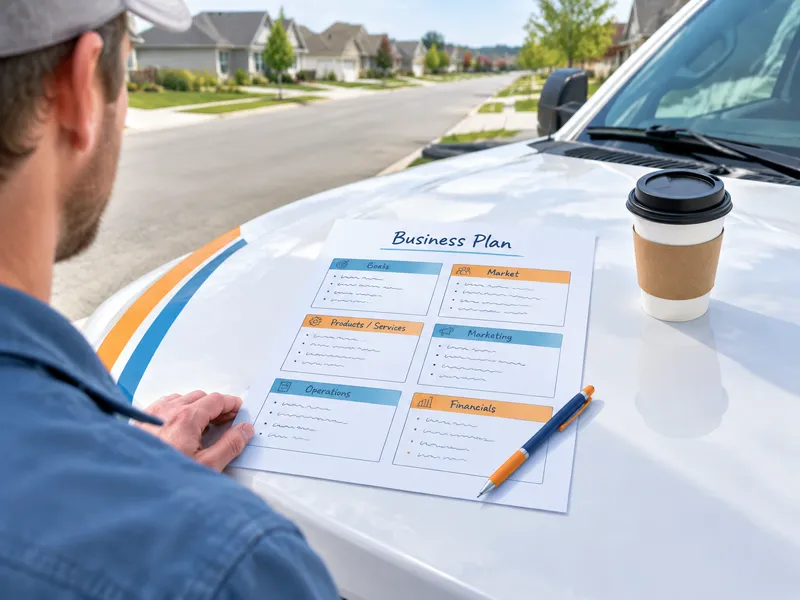
You do not need a bank-ready roofing business plan. You need to know what you are doing in March.
That is a different document from a startup plan written to win a loan. You already have a company, with crews, trucks, a calendar, and a market you are either winning or splitting.
So this is a plan for the owner who already has jobs to run: one page, six boxes. It answers one question. Where will the next twelve months of booked estimates come from, and can your crews handle them?
Here is where the planning usually falls apart:
- •Your plan is in your head, and it changes every Monday
- •You said yes to a job outside your market last month because the schedule looked thin
- •You could not say how many roofs the crews can finish in a quarter
- •Marketing happens when the schedule is empty and stops when it fills
- •A full week feels like proof, and you could not say if it was the plan or luck
Why a One-Page Roofing Business Plan Gets Used
Before we talk about boxes, ask what a plan is for. Is it a document to show someone, or a decision you intend to keep making? A plan that takes a weekend to write tends to get read once and filed, while one that fits on a page gets taped inside the truck and changes what you do on a Tuesday.
Why does the long version fail? It is written for a reader outside your company, such as a lender. You are not that reader, and you do not need to explain your town to yourself.
A single page does something else. It forces a choice. There is room only for the decisions that matter, so every box you cannot fill in plain words is a decision you have been putting off.
Consider this. The page is not the plan. The page shows you where you do not have one yet.
It also gives you something to say no with. A job outside your market looks like extra revenue until you see what a half-won second market does to the first. When the page says where you are playing, the answer on the phone gets easier.
The Six Boxes of a One-Page Roofing Business Plan
Draw a page with six boxes. Each box gets a few lines, not a paragraph. Fill them in this order, because the early boxes set the limits for the later ones.
- 01.
Pick your market
Decide where you will win in the next twelve months: a city, a set of neighborhoods, a kind of roof. Make it narrow enough that a competitor could read it and know which streets you mean. If the box says "the whole region," you have not chosen yet. - 02.
Say what you sell
List the work you want more of and the work you will take only when the schedule demands it: replacements, repairs, storm work, a small commercial niche. One line each. If commercial keeps coming up, decide whether commercial work belongs in the plan before it takes a box. - 03.
Count your capacity
Write down how many roofs each crew can finish in a quarter, then multiply by the number of crews. Use what your crews have actually done, not what they could do in a perfect month. This number is the ceiling, because demand past it makes you late. - 04.
Source your booked estimates
List where the next twelve months of booked estimates come from: referrals, repeat customers, Google, storm work, a partner who sends you work. Next to each source, write how much of the year it will carry, and note whether it depends on something you do not control. Slow months show up in this box first, so see how the roofers who stay busy through them plan 90 days ahead. - 05.
Pick three numbers
Choose three numbers, not twelve, to look at every week. Start with booked estimates this month and roofs on the schedule for the next six weeks, then add the share of the year your biggest source is carrying. Each one should take five minutes to pull from your own calendar. - 06.
Name what to stop
Name one to three things you will stop doing: a kind of job, a market, or a habit like taking every call without asking where it came from. If every decision still runs through you, you are the bottleneck in your roofing business, and the page should say what you will hand off.
If you cannot fill a box, write the word unknown and put a date next to it. A dated unknown is a task. An empty box is a habit.
Fill It In: A Worked Example
Here is one page filled in for a made-up company. The company does not exist, and the numbers are invented to show the arithmetic. They are not benchmarks, so use your own.
| Box | Example entry |
|---|---|
| Pick your market | Three neighborhoods and the two suburbs next to them. Nothing past the county line. |
| Say what you sell | Full residential replacements first. Repairs only when they can turn into a replacement. No commercial work this year. |
| Count your capacity | Two crews. Each has finished about ten roofs a quarter. That is 20 roofs a quarter, even though one roof per crew per week over 13 weeks says 26. |
| Source your booked estimates | Referrals and repeat customers carry about half the year. Google search and Maps carry about a third. Storm work is the rest, and it is not reliable. |
| Pick three numbers | Booked estimates this month. Roofs scheduled for the next six weeks. Share of the year carried by referrals. |
| Name what to stop | Taking jobs outside the five areas. Pausing marketing when the schedule fills. Chasing storm work outside the two suburbs. |
Box: Pick your market
- Example entry
Box: Say what you sell
- Example entry
Box: Count your capacity
- Example entry
Box: Source your booked estimates
- Example entry
Box: Pick three numbers
- Example entry
Box: Name what to stop
- Example entry
Read it again and notice what the page already settles: whether the crews can take the work, what happens if one source dries up, and what the owner says no to.
Notice what is missing, too. There is no revenue target, no margin, and no market size, because those belong in your books. The plan works without them, and a plan built on guessed numbers is worse than one that admits what it does not know.
Review It Quarterly in 20 Minutes
Put a date on the calendar now. Once a quarter, twenty minutes, the page in front of you. This is a check, not a retreat.
- •Capacity. — Did the crews finish what the page said they could? If not, change the number, not the story.
- •Sources. — Which source of booked estimates carried the quarter, and did any of them slip?
- •Numbers. — Did any of your three numbers move the wrong way for more than two weeks?
- •Stops. — Did you do something you said you would stop? Write down why.
- •Next ninety days. — What is the one change to the page for the quarter ahead?
Cross things out and write the new version beside them, because a page with edits on it is a page that is being used. Keep the old pages. After a year you will have four, and you will see how your own thinking changed.
What the Plan Is Not
Be honest about what one page cannot do.
- •It is not a loan application. — A lender, a surety company, or an investor may ask for a document with its own format and its own numbers. If that happens, ask them what they require. This page will sharpen your thinking, but it is not that document.
- •It is not a forecast. — Do not invent revenue numbers to make the page feel serious. Put in what you know and mark what you do not.
- •It is not a marketing plan. — It names where booked estimates come from. Choosing those sources is strategy, and building each one is a separate job.
The owner who can say in two minutes where the next year of booked estimates comes from is already ahead of the one who cannot.
►Do I need a business plan for my roofing company?
If you run jobs from memory and a calendar, you already have a plan. It is just unwritten, and easy to change by accident. A one-page plan makes it visible, so you can see what you decided and what you only drifted into.
►What should a roofing business plan include?
For an owner who already has jobs, six things: your market, your offer, your crew capacity, where booked estimates will come from, three numbers to watch, and what you will stop doing. Plans written for a new company often add startup cost and funding sections. You can skip those unless a lender asks for them.
►How often should I update my roofing business plan?
Once a quarter, for about twenty minutes. Change the page when something real changes, such as a new crew, a lost source of work, or a decision to drop a market. Do not rewrite it every week, or it turns back into a plan that lives in your head.
►How is a one-page plan different from a loan plan?
A loan plan is written for someone outside the company who needs to judge risk. A one-page plan is written for you, to decide what the next twelve months look like. It leaves out the company history and the projections. If a lender wants a plan, ask what format they require.
Consider box four, because it is the one a competitor can take from you. The Search-to-Booked Roofing System™ is built to put your company in front of homeowners who already need a roof, and to turn them into booked estimates.