
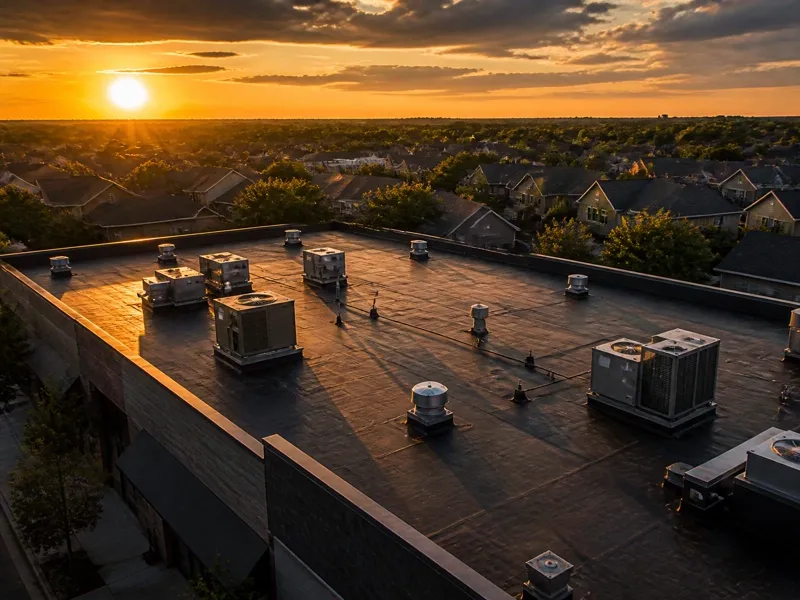
A flat roof on a strip mall. Forty squares of TPO. You already know what that pays.
One commercial contract. Ten residential jobs replaced on your schedule. That math is not hypothetical. It is sitting in every market in the country waiting for the roofer who knows how to go after it.
According to The Freedonia Group, the U.S. commercial roofing market reached 83.2 million squares in 2024. The pipeline is real.
The question is not whether to want it. The question is whether your company is built to go after it, and what actually changes if you decide to make the move.
Commercial is one kind of growth move. Geographic expansion into a new market is another. Either way, the right call is never made on ambition alone. It is made on what your numbers actually say you are ready for.
- •The slow months keep coming and you are tired of waiting them out
- •You have a solid residential operation but you are ready to grow past it
- •You won a small commercial job once and it paid slower than anything you had ever done
- •Someone told you commercial has better margins and you are not sure if that is true
- •There is a commercial property in your market nobody has called you about yet
Commercial Roofing Is a Different Business, Not a Bigger Version of Residential
Consider this.
Most roofers who think about commercial work are asking the wrong question. They ask: how do I get commercial roofing jobs? The right question is: what kind of company do I need to be before those jobs make sense to go after?
That distinction matters. Because commercial roofing is not a scaled-up version of what you already do. It is a genuinely different business. The materials are different. The buyers are different. The sales cycle is different. The cash flow is different.
Here is what changes across every dimension that matters.
| Residential | Commercial | |
|---|---|---|
| Buyer | Homeowner, emotional, urgent, decides fast | Property manager or building owner, methodical, budget-driven, decides slow |
| Sales cycle | Hours to days | Six months to a year |
| Materials | Steep-slope shingles | Low-slope membranes: TPO, EPDM, PVC |
| Payment | Full payment at completion | Retainage withheld, progress billing, net-30 to net-60 |
| Trust signals | Reviews, response speed, referrals | Certifications, bonding capacity, documented project history |
: Buyer
- Residential
- Commercial
: Sales cycle
- Residential
- Commercial
: Materials
- Residential
- Commercial
: Payment
- Residential
- Commercial
: Trust signals
- Residential
- Commercial
Each row in that table represents a real adjustment your business has to make. Not a minor one.
Industry survey data shows single-ply membranes are used on 81% of commercial roofing projects. TPO alone accounts for 41% of commercial installations. Your shingle crew does not automatically know how to heat-weld a TPO seam or detail a membrane at a parapet wall. That is a learned skill requiring equipment most residential operations do not own.
A homeowner with a leak is searching Google in a panic. She calls whoever shows up first, within hours. A commercial property manager is not panicking. She works from an approved contractor list built over years of referrals, certifications, and documented project history. By the time she calls you, she has already decided you are worth talking to. Getting on that list takes months. Staying on it takes years.
A residential job can close the day you knock on the door. Commercial contracts regularly take six to twelve months from first contact to signed agreement. You are carrying the cost of pursuing commercial for a long time before you see a dollar from it. Your residential operation has to fund that runway.
The roofers who cross into commercial successfully understood all of this before they started bidding. Not after their first loss.
The Financial Reality Before You Commit
Before we talk about how to go after commercial work, there is a number that determines whether any of this actually works.
Not margin percentage. Not job size.
Working capital.
The roofer who runs out of cash floating one large commercial job does not get a second chance at commercial work. He gets a lesson that costs him his residential operation too.
Before you pursue a single commercial bid, answer this honestly:
Can your business carry a job three to five times your average residential ticket and not collect full payment for 90 to 120 days?
If the answer is no, that is the first thing to fix.
Retainage is the cash flow reality most residential roofers are not prepared for. Commercial jobs typically withhold five to ten percent of each payment until the job is complete and signed off. You earn that money in week one. You collect it months later.
On top of that, commercial billing runs on monthly progress cycles certified by an architect or building owner before payment releases. No certification, no check. Net-30 to net-60 terms are standard on top of that.
If you are used to collecting full payment the day a job is done, commercial cash flow is a different world. A company that finances one large commercial job without understanding how payment actually works can find itself cash-strapped before the job is finished.
Bonding and insurance minimums go up too. Commercial buyers verify coverage before they hand you a contract. General liability minimums are higher. Bid bonds, performance bonds, and payment bonds are standard. If your current limits are sized for residential, get them reviewed before you start bidding.
Licensing is the one most roofers forget to check. Many states require a separate, higher-tier license for commercial roofing work. A residential license does not automatically cover it. Verify your state requirements before you bid. Operating without the correct license is a legal exposure that will cost far more than the job was worth.
On margins: yes, commercial gross margins can be strong. But commercial jobs are competitively bid. The buyer is sophisticated. You do not earn a premium because you showed up fast and had good reviews. You earn it through accurate estimating and clean production.
Track commercial gross margin separately from residential from your very first commercial job. If it runs below your residential margin after three or four projects, the problem is pricing and production. Fix that before you scale.
Three Signs Your Company Is Ready
Readiness for commercial is not about ambition. It is about whether your business can absorb what commercial demands before the revenue starts coming in. That same readiness question is the one addressed in you are the bottleneck in your roofing business — a business that cannot run without you is not ready to take on a second line of work.
The roofers who make this transition work have three things in place before they start bidding.
- 01.
Working capital or a credit line sized for large jobs.
Not savings that cover payroll. A dedicated reserve or line of credit sized for the jobs you are going after. If a $150,000 commercial job comes with $15,000 held in retainage and net-60 payment terms, your business needs to carry that gap without touching what keeps your residential crews running. The roofers who make commercial work fund it as a separate initiative. They do not pull from residential cash flow to finance the first bid. - 02.
Flat-roof capability, or a real plan to get there before you win anything.
You do not need to already be a TPO expert. But you need a plan before you win a job that requires it. Training, hiring someone who already has the skills, or a solid sub relationship with someone who does. Know which of those fits your timeline before you start bidding, not after. Win a commercial job and improvise the equipment situation, and the job will cost you more than you bid. - 03.
At least one manufacturer certification in progress.
Commercial property owners expect a No-Dollar-Limit warranty on major roofing systems, meaning the manufacturer covers the full repair cost with no cap. NDL warranties are only available through certified contractors. GAF, Carlisle, Johns Manville, Sika, and Firestone all offer commercial certification programs. The certification unlocks the warranty commercial buyers require and signals to property managers that you are a vetted, accountable contractor, not someone who showed up with a low bid and no track record.
The National Roofing Contractors Association reports that more than half of its members perform both residential and commercial roofing work. The ones doing it successfully did not stumble into commercial. They built toward it.
Three Signs You Are Not Ready Yet
This is not a stop sign. It is a checklist of prerequisites.
Every item below is fixable. None of them are permanent. But walking into commercial before you have addressed them is how solid residential operations get into serious trouble.
- 01.
Your cash reserves are thin and your residential cycle is funding everything.
If your business runs on the cash from last week residential jobs to cover this week payroll, you are not in a position to absorb commercial payment timelines. That is not a character flaw. It is a cash flow structure that works for residential and breaks on commercial. Build the reserve. Establish the credit line. Then go after commercial from a position of strength, not necessity. - 02.
Nobody on your crew has flat-roof experience and you have no plan to change that.
Flat-roof work is not something you figure out on the job. TPO heat welding, membrane detailing at penetrations and parapets, proper slope and drainage, these are skills that take time to develop. Mistakes show up as leaks months after you have collected payment. A commercial property manager who gets a leak callback on a roof you installed does not give you another bid. She tells every other property manager she knows. Get the training, hire for it, or build a sub relationship before you chase your first commercial job. Not after you win it. - 03.
You have no bonding capacity and your insurance is sized for residential.
Getting bonding capacity takes time. Sureties evaluate your financials, your work history, and your credit before they extend capacity. Starting that conversation after you find a commercial opportunity you want to bid is too late. Start it now, with your surety and your insurance broker, so that when the right commercial opportunity shows up, you are already qualified to pursue it.
How Commercial Changes Your Marketing
Consider this before you spend a dollar on commercial marketing.
The front door to commercial work is a completely different door. If you are waiting for it to ring the way your residential phone rings, you will wait a long time.
A homeowner with a leak opens Google, finds whoever shows up first in the Maps Pack, and calls within hours. The urgency drives the search. The search drives the call.
A commercial property manager does not work that way. She manages an approved contractor list she has been building for years. When a roof needs attention, she calls someone on that list. If you are not on it, you do not exist, regardless of how many five-star reviews you have or how strong your Google Business Profile is.
Your Maps Pack ranking and your homeowner reviews matter enormously for how residential calls actually come in. They are largely irrelevant to commercial buyers. Build them for residential. Understand they do not transfer.
When commercial buyers do search, they search by specification. Not roofer near me, but more like TPO roofing contractor or commercial roof maintenance program. Generic language about doing commercial work buried on your homepage does not rank for anything and does not convince anyone. System-specific pages do.
The trust signals that close commercial work are also different. Homeowners trust reviews and response speed. Commercial buyers trust certifications, bonding capacity, insurance limits, and documented project history. Build your commercial portfolio from the very first job. Photos, system specs, square footage, verifiable references. Every project you complete is a credential for the next one.
The channel that works for commercial is direct outreach. Property managers are not waiting to discover you. You have to find them through LinkedIn, commercial real estate networks, and associations like BOMA, the Building Owners and Managers Association, where property managers actually network.
Commercial relationships take time. A property manager with no roof project today might have one in eighteen months.
If you stayed in contact, you are on her list when that project materializes. If you made one call and moved on, you are not.
Run both tracks at the same time. Do not slow down residential while you build commercial. Your residential pipeline is what funds the commercial build. Keep it healthy. The roofers who cross over successfully almost always run both tracks for at least a year before commercial starts carrying real weight.
►How long does it take to land the first commercial roofing job?
Plan for six to twelve months from when you start actively pursuing commercial work to when you close your first meaningful contract. That accounts for building relationships with property managers, getting credentials in order, and working through a sales cycle that moves nothing like residential. Some roofers close something sooner. Most do not. Budget the runway and keep residential running the whole time.
►Do I need a separate license to do commercial roofing?
It depends on your state and the answer matters before you bid, not after. Many states issue separate residential and commercial contractor licenses, with commercial requiring higher bonding, more documented experience, and sometimes a separate exam. Check your state contractor licensing board before you pursue your first commercial bid. Operating without the correct license is a legal exposure that will cost far more than the job was worth.
►Can I run residential and commercial at the same time?
Not only can you, you should. Your residential operation provides the cash flow that funds the commercial build. Trying to switch cold into commercial while winding down residential leaves you stranded between two lines of work with neither one producing. Keep residential healthy. Pursue commercial alongside it. Give yourself at least a year of running both before commercial starts carrying weight on its own.
There is one more prerequisite that never shows up on a bonding application. If your residential pricing is still reactive, set against whatever the competitor down the street charges, commercial work will not fix that. It just gives the same underlying problem a bigger invoice. Get your own pricing position solid before you go looking for a second line of business to prove it in.
Commercial work is worth building toward. The market is real, the jobs are large, and the roofers who make the move correctly end up with a business that is harder to compete against and more valuable to own. But the ones who get there are almost never the ones who chased commercial because residential was not working. They built a residential operation stable enough to fund something new. If the phone goes quiet in January, if you are still the one hunting every job, if your crews are inconsistently busy, those are the things worth fixing first. A residential pipeline that fills without you chasing every job is what gives you the bandwidth to pursue commercial on your terms. That is exactly what the Search-to-Booked Roofing System™ is built to do.