
You sent three estimates last week. Do you know where each one stands right now?
Not where you hope it stands. Where it actually stands, who owns the next call, and what day that call happens.
If you cannot answer that for all three, the fix is not another roofing sales training course that gets half watched and forgotten. It is thirty minutes, once a week, with every open estimate on the table.
You have lived some of this:
- •An estimate you sent two weeks ago and never heard back on.
- •A rep who says "I am working on it" and cannot say what he did.
- •Nobody remembers which homeowner asked for a call back.
- •The sales review happens when you lose a big one.
- •You keep promising to train the crew next month.
This post gives you the whole meeting: the agenda, what to look at on every open estimate, and how to coach one habit a week.
Why One Short Meeting Beats a Roofing Sales Training Course
A training course teaches your crew how selling works in general. A weekly meeting works on your estimates, this week, with the homeowner's last name on the line.
Those are not the same job.
Think about the last course you bought, or the last one a rep asked you to buy. How many estimates on your board moved because of it?
A course cannot see your open estimates. It does not know which one has sat for days with nobody assigned. A meeting does, and because it happens every week, a stalled estimate gets caught this week.
I am not claiming a weekly meeting raises your close rate. The timing below is my judgment, not a study. The claim is smaller: you cannot coach what you cannot see.
This meeting is the weekly routine that sits on top of the stages of the roofing sales process. That post maps the stages. This one makes you look every week.
The 30-Minute Weekly Sales Meeting Agenda
Same day, same time, same place every week. Put it on the calendar like a crew start time, and pick a slot when your reps are not on a roof.
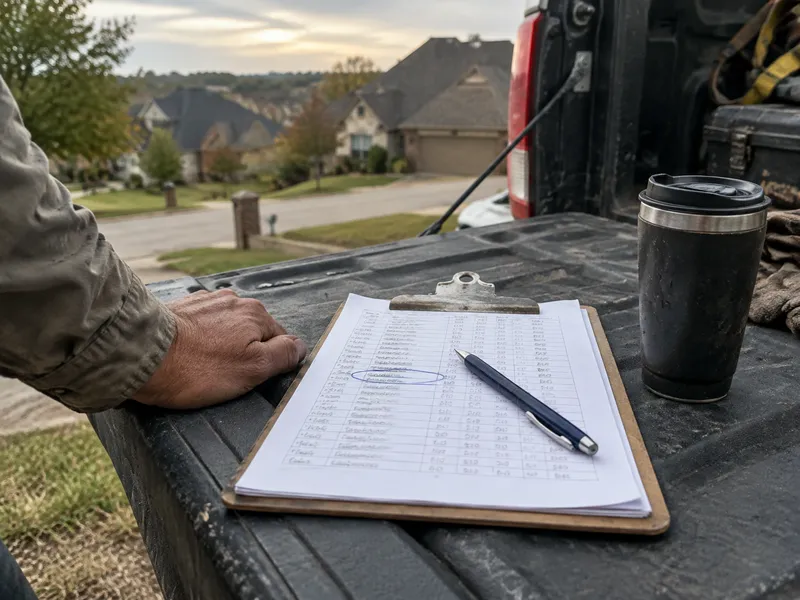
Bring one printed list of every open estimate: homeowner last name, dollar amount, date sent, date of the last real contact, next step, and owner. Then run it in this order.
- 01.
Minutes 1 to 5: Last week's booked estimates.
Open with one question: did last week's habit happen? (Skip this the first week.) Then go through the estimates that landed on your calendar last week and say where each one stands now: ran, sent, signed, or slipped. Keep it moving. - 02.
Minutes 6 to 15: Every open estimate, oldest first.
Go down the list from the oldest to the newest. Spend about thirty seconds on each, and say three things only: how old it is, what the next step is, and whose name is on it. Do not solve anything yet. Thirty seconds each fits about twenty estimates, and a longer list tells you something too. - 03.
Minutes 16 to 25: One stalled estimate.
Pick the estimate that has gone longest without a next step and work it out loud with the rep who owns it. Ask three things: what did the homeowner say last, what one thing would move this forward, and who makes the call by when. Write the answer next to the homeowner's name before anyone leaves. - 04.
Minutes 26 to 30: One habit to coach.
Name one habit for the week. Not five. Say it in a sentence everyone can repeat, and say how you will know next week whether it happened.
That is the whole meeting. If it runs past thirty minutes, you are solving instead of surveying. Write the item down and move on.
If you are the only one selling, run it alone on Monday morning with the same list. Say each estimate out loud anyway. When the next step is a call, see why a day three follow-up closes more roofing jobs for the timing.
What to Look at on Every Open Estimate
Three things on every line of the list. Nothing else gets airtime in the ten-minute pass.
- •Age. — Count the days since the estimate was sent, not since the inspection. The clock she feels starts when the number lands in her hands.
- •Next step. — A next step is a call or a visit with a day on it. On an insurance job, it is the day you call after the adjuster's visit. "Waiting to hear back" is not a next step. It is the absence of one.
- •Owner. — One name. Not "the office" and not "we." If two people own an estimate, nobody does.
Here is how the answers sound when an estimate is healthy and when it has stalled:
| The question | A healthy answer | A stalled answer |
|---|---|---|
| How old is it? | Sent this week, with a call on the calendar | Sent two weeks ago, no contact since |
| What is the next step? | Call Thursday to walk her through the numbers | Waiting to hear back |
| Who owns it? | One name and one day | Whoever has time |
The question: How old is it?
- A healthy answer
- A stalled answer
The question: What is the next step?
- A healthy answer
- A stalled answer
The question: Who owns it?
- A healthy answer
- A stalled answer
Any estimate with stalled-column answers is your candidate for the stalled estimate in step three.
If a rep keeps skipping the call, ask what he is afraid of. Sometimes it is sounding pushy. A call with a day on the list takes that choice out of his hands.
Do not argue about whether it is dead. Give it a next step and an owner, or take it off the list.
Coach One Thing a Week
By the time the list is done, you will see several problems. Pick one. A rep who walks out with five things to fix leaves with none.
Choose the habit from what your list showed you today, not from what you read last night. Here are three that come straight off the three things above. They are examples, not a script:
- •Every estimate leaves with a call on the calendar. — This fixes the next step.
- •Every estimate has one named owner before it goes out. — This fixes the owner.
- •The call happens on the day we said, or the rep tells you why. — This fixes age, because the days stop piling up quietly.
Say the habit in one sentence. Next week, open the meeting with one question: did it happen? If yes, pick the next habit, and if no, run the same one again.
If your habit is about the moment a homeowner goes quiet after the price, read the objection she will not say out loud.
You are not grading anyone. You are making one small habit normal, then the next, with your own estimates as the proof.
What to Skip: No Pep Talks, No Quota Theater
A short meeting stays short because of what you leave out.
- •Pep talks. — A speech does not move an estimate. A next step does. If the room needs energy, the list is not specific enough.
- •Quota theater. — Reading out a number everyone already knows does not change what happens on Thursday. Look at the estimates behind the number instead.
- •Blame. — The point is to find where an estimate stalled, not who stalled it. If reps expect a grilling, they will tidy the list before the meeting instead of showing you the real one.
- •Software. — A printed list is enough. Add a tool later if the habit sticks.
One list, one stalled estimate, one habit, thirty minutes.
Frequently Asked Questions
►How often should a roofing company hold a sales meeting?
Once a week, on the same day at the same time. Thirty minutes is enough because the list does the work and the only preparation is printing it. If you are the only one selling, run it alone with the same list and say each estimate out loud.
►What should a roofing sales meeting cover?
Four things, in this order: last week's booked estimates, every open estimate by age, one stalled estimate worked out loud, and one habit to coach. Leave out pep talks, quota theater, and long training sessions.
►How do I train roofing sales reps without a course?
Use the weekly meeting. Each week, pick one habit from what your own list shows, say it in one sentence, and check it the next week. After a month you have four habits tied to real estimates, and your reps can see them on the list.
►What do I do when an estimate has gone quiet?
Give it a next step and an owner before the meeting ends. Put a call on the calendar with a day on it. If she gives you an honest no, take the estimate off the list and write down why.
The Search-to-Booked Roofing System™ is built to put booked estimates on your calendar. The meeting above is how you keep track of every one of them.