
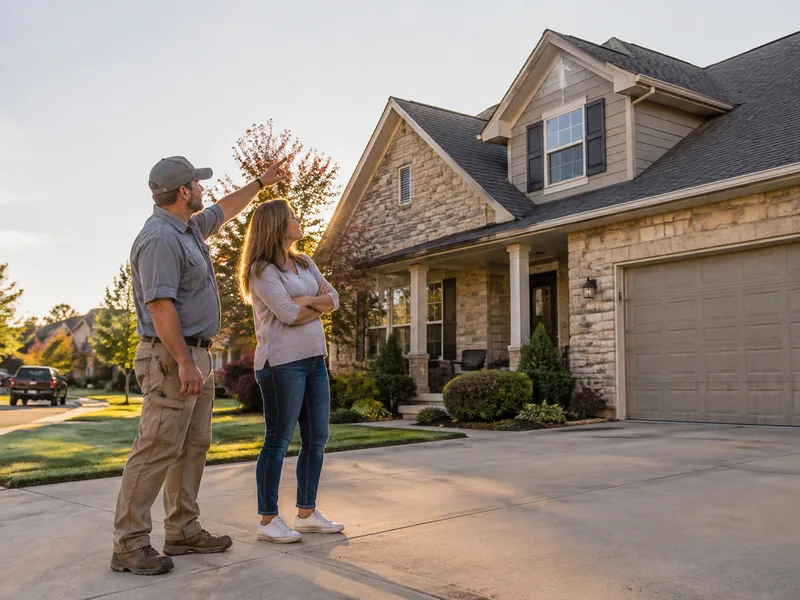
What is your roofing sales pitch actually trying to do on the first call?
If the answer is win the job, you are asking it to do a job it was never built for.
She called to find out if you are worth a visit. Buying a roof comes later.
Some version of this has landed on your week:
- •She asked how much, and your rep gave her a number before anyone had been up on the roof.
- •Your guy stood on her porch walking through shingle brands, and she had not asked one question.
- •She said just email me a quote, and you did.
- •You had a great call, hung up feeling good, and she never picked a day for anyone to come out.
Four different moments. One mistake. Somebody played for the sale when the moment was only there to earn a visit.
Here is what actually happened. The first call and the first knock have one job. They book the inspection.
Everything else a rep says in those first minutes either helps that or gets in the way. This post sorts out which is which.
What the First Call and the First Knock Are Actually For
You cannot give a firm price on a roof you have not looked at. You already know this.
So why does the first call so often turn into a price conversation?
Because it feels like service. She asked a question. You have an answer.
A number on the phone is a guess with your name on it.
Here is the moment it goes wrong. She asks how much, and your rep throws out a range because he wants to be helpful. Now she has a number in her head, and nobody has been on her roof.
That range becomes the frame for everything after it. The inspection stops being a first look and turns into an argument with a number you guessed on the phone.
The first contact has one job. It earns the visit.
Not the signature. Not the price. A day, a time, and a homeowner who is expecting you.
Inspection here means the visit where somebody gets eyes on her roof. The estimate comes out of that visit, not before it.
The door works the same way. The first knock is not a sales talk. It is a request to look at something she has never seen the way you will.
If you are still losing the call before you get to this part, start with why the roofer who answers first still loses the job. That post is about how you sound in the first fifteen seconds. This one is about what you are asking for once you have her attention.
Book the inspection. The rest of the call exists to protect that one thing.
What She Is Deciding in Those First Minutes
She is not deciding whether to buy a roof. Not yet.
She is deciding whether to give you her afternoon.
Think about what a visit costs her.
A stranger on her property. A sales talk she did not ask for. An hour she was going to spend on something else.
So while you talk, she runs three quick checks:
- •Will he actually show up? — She has heard a story about a contractor who never did. A specific day and time, said out loud, answers this one.
- •Will he start selling the minute he gets here? — If the call sounded like a closing pitch, she assumes the visit will too.
- •Is this worth my time? — She needs to know what she gets from the visit even if she never hires you. Someone looks at the roof and tells her the truth about it.
Notice what is missing from that list. Price, shingles, warranty.
She will care about all of it later.
Right now she is asking a much smaller question. A small question deserves a small yes.
A lot of the roofing sales techniques you were taught assume she is ready to decide. She is not. She is ready to let someone look.
That is one reason the rep who pitches the whole job on the first call gets "let me think about it." He asked for a big decision, so she gave him the answer people give to big decisions.
Ask for the small yes. Make it easy to give.
Four Roofing Sales Pitch Lines That Book the Inspection
Here are four moments where the first contact goes sideways. Each one has a line that keeps it pointed at the inspection.
Do not turn them into a roofing sales script.
Scripts get recited. Principles get used. Say it your way and keep the move.
- •She asks how much. Make the visit the answer. — "Fair question. I don't want to guess on a roof I haven't seen, because a guess does nothing for you. I'd rather put eyes on it first, and then you get a real number from a guy who has been up there."
- •She hesitates at a stranger on her roof. Say exactly what happens. — "Totally fair. Here is how it works. He looks at the roof, shows you what he finds, and tells you straight what it needs, even if the answer is nothing. He is not going to push you into anything while he is there."
- •She asks whether she even needs a new roof. Tell her that is what the visit is for. — "Nobody can tell you that from a phone. Sometimes it is a few shingles. Sometimes it is the whole roof. That is what the look is for, and you will know before you spend a dollar."
- •You are standing at her door. Ask for a look, not a meeting. — "Hey, I'm Marcus with [Company]. Mind if I take a look at your roof from the driveway and tell you what I see? Two minutes, and if I see nothing, I'll tell you that too."
Every line does the same three things: it tells her the truth, it makes the visit small, and it keeps the next step on the table.
None of them open with credentials, shingle brands, or warranties. They do not need to yet.
One rule. Only say what is true at your company. If your reps do push at the visit, fix that before you teach anyone these lines.
Why the Inspection Is Where the Roof Gets Sold
On the phone, you are a voice making claims. At her house, you are a person showing her something true.
Here is what she gets at the visit that she never gets on a call.
She sees the roof. She sees what you see. Nobody has to ask her to take your word for it, because she is looking right at it.
A claim has to be believed. A photo of the cracked flashing does not.
So the rep's job at the inspection is not to pitch. It is to show. Walk her through what he found, in plain words, with the evidence in front of her.
Tell her what is fine, too. A roofer who points out what is not wrong is a roofer she believes about what is.
This is where the sale starts. Not with a number. With a homeowner who just watched a stranger tell her the truth about her own roof.
By the time the price comes up, you are not asking her to take your word. She has already seen the reasons.
That is the real cost of selling hard on the first call. Every minute you spend selling a roof she has not seen is a minute spent asking her to trust a voice, when you could be earning the right to show her.
What happens after the inspection, at the kitchen table, is its own fight. An estimate can be perfect and still lose the job, and the retail estimate has its own rules.
This post ends when you come down off the roof. Book the inspection. Then go show her.
►What is a good roofing sales pitch?
The one that books the inspection. A good roofing sales pitch on the first call or knock is short, true, and aimed at one thing: a day and a time for someone to look at her roof. Selling the roof comes later, after she has seen what you found.
►Should a roofer give a price over the phone?
Not a firm one. A price on a roof nobody has looked at is a guess, and once she has the number it frames the whole visit. Tell her you will not guess on a roof you have not seen, and offer the inspection instead.
►What do you say when a homeowner asks "how much" on the first call?
Tell her the truth and make the visit the answer. Something like: "I don't want to guess on a roof I haven't seen. Let me put eyes on it first, and you'll get a real number from someone who has been up there." Say it in your own words and keep the move.
►How do you pitch a roof inspection at the door?
Ask for a look, not a meeting. Something like: "Mind if I take a look at your roof from the driveway and tell you what I see?" Keep it small, and promise only what your company really does, including telling her when the roof is fine.
Everything in this post starts after a homeowner is already talking to your rep. The Search-to-Booked Roofing System™ fills your week with homeowners who already want a roof looked at, so your reps spend the first minute booking, not chasing.