
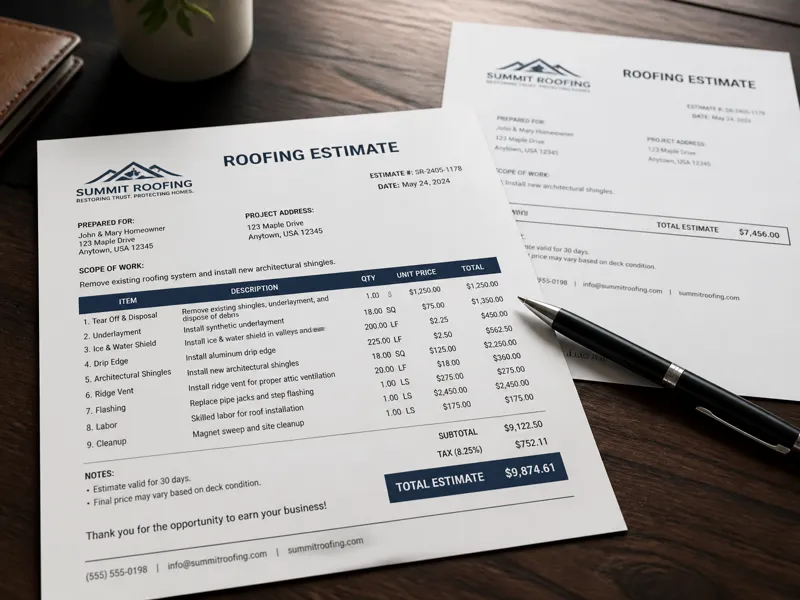
You bid a job at $18,400. Your competitor bid $16,900. He won.
You lost by $1,500. But that is not the real problem. The real problem is you cannot tell him why your number was right and his was low. Neither can the homeowner who trusted her gut and picked the cheaper one.
This happens every week to nearly every roofing company in the country. It is almost never about being outpriced. It is about being out-proved.
You already know the pattern.
- •You quote a fair number and lose the job to a bid $1,500 lower with no explanation of what it includes.
- •You win a job at the low number and realize on payday you barely cleared labor.
- •A homeowner asks 'why is yours higher' and you do not have a clean answer ready.
- •You write 'roof replacement: $16,900' on one line and call it an estimate.
- •Your best crew sits idle two days because a $14,000 bid took the job you should have had.
- •You raised your price last year and started losing jobs you used to win without thinking about it.
The estimate that wins is not always the cheapest one. It is the one the homeowner can actually read and believe. Here is the math behind why, and how to build one that holds up the next time a lower bid lands on the kitchen table beside yours.
Why a Lower Number Loses to a Clearer One
A homeowner comparing two roofing estimates is not comparing roofers. She is comparing two documents. One says 'Roof replacement: $16,900.' The other breaks the same job into eleven lines: tear-off, disposal, decking repair, underlayment, shingles by grade, flashing, ventilation, permit, cleanup, and warranty terms, each with its own number.
The single-line bid looks cheaper. It is also unreadable. She has no way to know what is inside that $16,900, so she cannot compare it to anything except your $18,400. The comparison she ends up making is not whose roof is better. It is whose number is smaller.
The itemized estimate changes the comparison entirely. Now she is not choosing between two prices. She is choosing between a number she cannot verify and a number she can trace, line by line, back to what actually goes on her roof.
That is not a sales trick. It is math doing the work a lower number cannot do. A price without a breakdown is a claim. A price with one is evidence.
The roofing market is already splitting into two tiers built on exactly this distinction. Roofers who compete on price and roofers who compete on proof are ending up in very different places.
Sometimes the number was never the problem in the first place. The estimate was already right and the job was still lost anyway.
What a Line-Item Estimate Actually Proves
Every line on a real estimate answers a specific question the homeowner has not asked out loud.
Materials, listed by grade and spec, answer what am I actually getting. A generic shingles line answers nothing. Naming the exact grade, the impact rating, and the manufacturer warranty attached to it explains $2,000 of the number without you having to say a word.
Labor, priced separately from materials, answers how much of this is skill versus stuff. A four-person crew running two days on a 28-square roof with two layers of tear-off costs more than a two-person crew running one day on a bare deck. She does not need to know your labor rate. She needs to see that the number moved because the job moved.
Disposal and permit fees answer is this roofer doing this the right way. A separate permit line and a separate disposal line are not padding. They are proof you are not skipping the parts of the job that keep her house code compliant and her yard clean.
Warranty terms, priced as their own line, answer the question she is most afraid to ask: what happens if this fails in year six. A workmanship warranty with a dollar value attached is worth more to her than a verbal promise, because a number she can point back to later is not backed by a memory of what you said in her kitchen. If that line names a manufacturer warranty, confirm you are allowed to offer it before it goes on paper. One of GAF's strongest warranties is limited to Master Elite contractors with annual volume minimums.
How to Build an Estimate That Holds Up Against a Cheaper Bid
Building this only takes five categories, not fifty. Break every proposal into these five lines, and you have an estimate that argues for itself before you ever open your mouth.
- 01.
Materials, by grade and spec.
Name the shingle grade, the underlayment, the flashing metal. If you use better materials than the roofer who bid $1,500 less, this is the line that says so. - 02.
Labor, scoped to the actual job.
Crew size, days on site, layers of tear-off if any. This is where the number moves when the job is harder than the roof next door. - 03.
Disposal and permit.
Two lines, not one buried number. This is where you prove you are not the roofer who dumps shingles in a field and skips the inspection. - 04.
Warranty, priced as its own line.
Workmanship warranty length and what it covers, with a dollar value attached. Not a sentence at the bottom of the page. A line item. - 05.
Total, with the four lines above it still visible.
Never remove the breakdown once you have built it. The moment you go back to a single number, you go back to being the roofer with the number nobody can verify.
The Margin You Protect When You Stop Rounding Down
Here is what a single-line estimate costs you that has nothing to do with losing the job. When your only lever is one number, your only move against a cheaper bid is to lower that number. You round $18,400 down to $17,900 because the competitor's $16,900 is sitting on the same kitchen table. You just took $500 out of a margin you had already calculated correctly, and you did it with no idea whether it changed anything.
An itemized estimate gives you a different lever. If the homeowner pushes back on price, you do not cut the total. You walk the lines. You show her the materials line is the difference. You show her the warranty line is the difference. The number does not move, because you now have a reason for it to stay where it is.
In No B.S. Price Strategy, Dan S. Kennedy and Jason Marrs make the case that a business that cannot explain its price cannot defend it. The line-item estimate is that explanation, built into the document itself, before the conversation ever happens.
A 1% price increase on a $10,000 roof is $100. If you do 80 roofs a year, that is $8,000 you left on the table by rounding down instead of proving up. Most roofing companies keep less of what they earn than they think.
►Does itemizing just give the homeowner a shopping list to negotiate against?
No. A shopping list has no reasoning attached to each line. An itemized estimate does. She can question a number, but she cannot argue with a grade of shingle you refuse to install. The lines that hold up are the ones built on your standards, not around her budget.
►Should markup be visible on each line, or built in?
Built in. Materials and labor lines should reflect true delivered cost including your margin, not a separate markup line. Showing a separate markup line turns your profit into a negotiating target. Pricing each line to already include your margin keeps the number defensible without inviting a debate about what you are allowed to earn.
►What if my competitor's total is still lower after I itemize?
Then the itemized estimate already did its job. If his total is lower because his materials, labor, or warranty are genuinely less, she now knows what she is trading for that savings before she signs, not after the roof leaks. You are not trying to win every job on price. You are trying to make sure the jobs you lose on price are jobs you were right to lose.
The same standard applies to your marketing spend as it does to your estimates. If you cannot see the line-item return on what you are paying for calls, clicks, or a scorecard nobody can explain, you are looking at a single number you cannot defend either.