
Most roofing owners believe the best company wins. The best crew. The best price. The best warranty.
That is not what happens.
The company that shows up first wins. First on the map. First on the search page. First in the AI answer. Everything else is a distant second place, no matter how good the work is.
The Misconception That Keeps Roofers Off the Map
Ask a roofing owner why they lose jobs and you will hear the same answers. The other guy was cheaper. The homeowner already had a cousin in roofing. The lead was tire-kicking.
Some of that is true. Most of it is a coping story. The real answer is quieter and harder to accept.
The homeowner never saw you. They saw three roofing companies at the top of Google. They picked from those three. You were somewhere on page one or page two, but by the time they got there, they had already called someone.
You did not lose on price. You lost on position.
What Homeowners Actually Do Before They Call
A homeowner with a leak does not open a phone book. They do not ask their neighbors first. They do not drive around looking for trucks with logos on them.
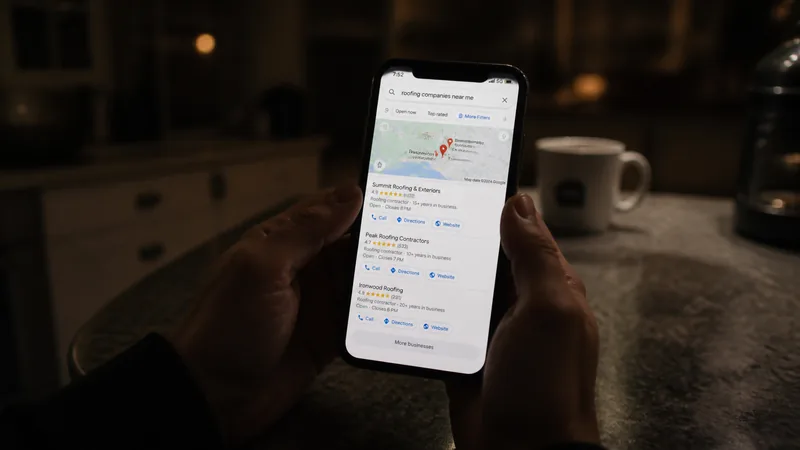
They pull out their phone and search. Usually something like "roofer near me" or "roof repair" plus their city. Google shows them a map with three roofing companies at the top. Below the map, a list of websites.
Then the homeowner does what everyone does. They tap on the first company that looks like it actually covers their neighborhood. They look at the star rating. They read one or two recent reviews. They click the call button.
Review reading is not occasional. It is routine. According to BrightLocal's 2026 Local Consumer Review Survey, 97% of consumers read reviews before choosing a local business. 41% now say they always read them before calling. That number jumped from 29% in just one year.
If the roofer answers, that call often becomes a booked estimate. If it goes to voicemail, the homeowner taps back and calls the second company on the list. Then the third. By the time they hit the fourth, the homeowner has usually already booked with someone.
The whole thing takes under five minutes. If your company was not on the map, you were never in the race.
The Business Consequence Nobody Talks About
This is the part that costs roofing owners the most money, and almost nobody adds it up.
Every homeowner who searches for a roofer and does not see you is a job that quietly went to a competitor. You never got a phone call. You never got a voicemail. You never got a bounced email. There is no record of that lost job anywhere in your business.
Multiply that by every day of every month. In a decent sized market, dozens of homeowners search for a roofer every week. If you are not in the top three on the map, most of them will never know you exist.
Roofing owners often chase the leads they can see. Referrals. Repeat customers. Storm door knocks. Those leads matter. But they are a fraction of the market. The bigger opportunity is sitting inside a search result you are not showing up in.
That is a slow bleed. It does not feel like a crisis. It feels like a normal month.
Why Your Competitor Keeps Winning the Neighborhood
The roofer who shows up first is not always the best roofer. Sometimes they are new. Sometimes their crew is smaller. Sometimes their prices are higher.
They win because they built the right signals. A complete Google Business Profile. A steady flow of recent reviews. Photos from actual jobs. Service pages that describe the work. Consistent business information everywhere their name appears. That is the exact signal stack broken down in why the map pack is where the calls actually come from. Adding a new service line is one of the fastest ways to grow that stack. It opens an entirely separate set of search terms a single-trade competitor cannot touch.
None of that is glamorous. It is not the kind of thing a roofing owner brags about at a supplier lunch. But it is what Google uses to decide which three companies to put at the top of the map.
Once a company is at the top, it stays there. More calls. More reviews. More activity. That activity feeds back into the ranking. The gap widens every month. Your competitor is not just winning today. They are building a moat.
What Smart Operators Do Differently
The roofing owners who take position seriously stop asking whether their marketing is working. They start asking a simpler question.
When a homeowner in my service area searches for a roofer, do I show up in the top three on the map?
If the answer is no, everything else is a distraction. Not the website redesign. Not the truck wraps. Not the yard signs. Not the flyer campaign. Fix the position first. Everything else works better once the top three problem is solved.
Smart operators treat local search position the way a general contractor treats a foundation. If it is wrong, nothing built on top of it holds up. If it is right, everything else gets easier.
What the Next Three Years Look Like
Local search is not getting less competitive. It is getting more crowded, more automated, and more unforgiving of roofing companies that ignore it.
AI answer engines are pulling from the same signals Google already uses. When a homeowner asks ChatGPT for a roofer in their city, the answer often comes from the same top-ranked businesses that dominate the map. Position on Google is quietly becoming position everywhere.
AI search is already changing homeowner behavior. A 2026 Scorpion study cited by Contractor Magazine found that 22% of homeowners now go to ChatGPT first when they need a contractor.
That means the roofers who own the top three today are extending their lead into places most of their competitors have not started paying attention to yet. In three years, the gap between the visible roofers and the invisible ones will be much wider than it is now.
The good news is that the fix is not exotic. It is the same fundamentals that have always mattered, done consistently, in the right order. The roofers who start now will still be at the top when everyone else finally figures out what is happening.
The ones who wait will spend the next three years wondering why the phone got quiet.
The Search-to-Booked Roofing System™ Scorecard walks through the same signals Google, AI, and homeowners use to decide who to trust. Ten minutes. Free. Built for roofers.