
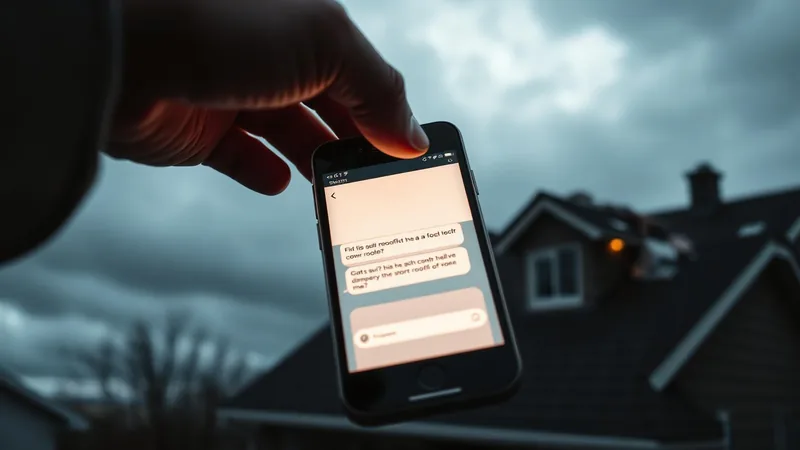
No roofing company got recommended by ChatGPT because they asked to be.
They got recommended because they built something real. ChatGPT found it.
That is the whole story. The roofing industry is about to spend two years learning it the expensive way.
The Question That Is Already Costing Owners
Every roofing Facebook group is running this conversation right now.
How do I get ChatGPT to recommend my company? Is there a listing? A form? Something to submit?
There is no form.
ChatGPT is not a directory. It is a system trained on everything already on the open web about your business. Reviews. Citations. Your website. Third-party mentions.
That is what AI reads. That is what it draws conclusions from.
The companies that understand that are quietly pulling ahead. The companies that do not are about to spend real money on the wrong problem.
What A Homeowner Actually Does Before They Call
The adjuster is still on the phone. The neighbor across the street already has a crew in the driveway.
The homeowner is standing in the backyard looking at the damage. They are not handing this job to whoever shows up first.
They pull out their phone.
Some type "roofer near me" into Google. But a growing number do something else. According to a 2026 Scorpion national study cited by Contractor Magazine, 22% of homeowners now go to ChatGPT first when they need a contractor. And BrightLocal found that AI use for local business recommendations jumped from 6% to 45% in a single year.
One year. Six percent to forty-five.
That is not a gradual shift. That is a market rewriting itself.
The question they ask is not "who has the best ads." It is "who is the best roofer in my city" or "is this company any good." They want permission to trust someone with a $15,000 job and months of insurance paperwork.
AI feels objective to them. Not a paid placement. Not a billboard. Something that already did the homework.
That feeling is now baked into every buying decision in roofing. The only question is whether your name comes back as the answer.
What AI Is Actually Reading
The misunderstanding going around is that AI search requires something new.
A new content format. A new platform. A new technical setup.
It does not.
Gartner projected in 2024 that traditional search volume would drop 25% by 2026 as AI became the substitute answer engine. That shift is arriving faster in local service markets than most analysts expected.
AI forms its opinion about a roofing company from the credibility picture that company built online. Reviews. Whether those reviews get responded to. Citation consistency across directories. Website content that addresses what a homeowner actually needs to understand before calling. That same credibility picture is what decides your position in the Maps Pack, the three-listing block most homeowners still see before they ever open an AI assistant.
Third-party mentions. Local news coverage. The footprint you built, or did not build, over time.
AI did not create new trust signals.
It made weak trust signals harder to hide.
A company with 14 reviews from 2022 and a half-maintained GBP does not have an AI problem. They have a credibility problem. AI is showing it in a new place. This is the same idea behind why chasing AI optimization tactics is the wrong starting point.
The Mistake That Is About To Be Expensive
Two waves always follow a new channel.
The first wave builds real infrastructure. The second wave buys things that look like infrastructure.
For AI search, the second wave is already here. AI SEO packages. ChatGPT citation reports. New content frameworks designed around a problem that does not respond to new tactics.
Most of it is theater.
Search Engine Land called Gartner's prediction "aggressive, but directionally accurate". That is exactly the right read. The direction is not in question. Roofing companies that try to game AI the way they once gamed early Maps Pack rankings will end up in the same place.
A lot of activity. Not a lot of calls.
AI visibility is not a separate project with its own line item. It is the downstream result of the credibility you either have or do not have. If the foundation is right, AI reflects it. If the foundation is weak, nothing built on top of it holds.
What This Costs A Business That Gets It Wrong
Picture the market you are in.
One company has been consistent. Reviews every week, not just after a good month. Every review responded to.
BrightLocal found that 88% of consumers will choose a business that responds to all its reviews. That compares to 47% who would choose one that does not respond at all. That gap is not a review management stat. It is the exact credibility signal AI reads when it decides who to surface.
Their GBP is active and accurate. Their website answers real homeowner questions for that specific market. Their citations are clean across every directory that touches local search.
A homeowner asks ChatGPT for a roofer. That company comes back.
Your company, with 22 reviews from 2021, an old number still in the GBP, and a stock photo on the homepage, does not.
You are not losing that job to a better roofer.
You are losing it to a better picture.
What The Smart Operators Are Doing Right Now
Nothing exotic.
They collect reviews every week, not in bursts. They respond to every one. Response behavior is part of the credibility picture AI reads when it decides whether a company is worth recommending.
Their GBP reflects what the business is doing this week. Not four years ago.
Their website was written for the skeptical homeowner. It answers real questions about materials, timelines, cost, and what to expect. A homeowner lands on it uncertain. They leave confident.
Their information is consistent everywhere a homeowner might check. Google. Yelp. Facebook. Apple Maps. The name, number, and service area do not shift depending on which window someone looks through. That same consistency problem shows up when your service area is smaller than you think.
That consistency is what AI synthesizes into a recommendation.
Not a trick. Not a tactic. Evidence, built steadily over time, that this company is the real thing.
The company that started building 18 months ago is very difficult to catch overnight. The company that starts today begins building that lead. The company that waits is going to find it more expensive when it finally moves.
The homeowner who opens ChatGPT to find a roofer is not making a decision in that moment.
The decision was shaped by every week of credibility you built, or did not build, before they ever asked.
By the time they ask, the answer is already written. Make sure you wrote it.
The Search-to-Booked Roofing System™ Scorecard shows you exactly where your credibility gaps are before a homeowner finds them first. Ten minutes. Free. Built for roofers.